Close-ups and Long-shots By Michael G. Ankerich


Hairpins and Dead Ends: A review by Diane MacIntyre
Hairpins and Dead Ends: The Perilous Journeys of 25 Actresses Through Early Hollywood
By Michael G. Ankerich
Reviewed by Diane MacIntyre.
This is companion book to his Dangerous Curves ‘a top Hollywood Heels– The Lives and Careers and Misfortunes of 14 Hard-Luck Girls of the Silent Screen. It’s not hard to imagine Hollywood as a treacherous goldfields that
stretch beyond the horizon. The miners are minors who have no inkling
of what being a screen star is or refuse to believe there is no gold for
them.

Edwina Booth’s quest for fame almost killed her
Yes, some will hit a vein, nuggets here and there. Some will find the finest gold sand and powder that slip through their fingers so rapidly and finally only fools gold. There is a price to pay for every bit. What Hollywood gives with one hand it takes away with the other. Rabidly, painfully even deadly.

Alma Rubens: Going, going . . .
The victims are of their own making from a deep burning fire in their
bellies to succeed where only a tiny fraction do-for a time.
Youth is everything. Actress Belle Bennett was willing to call her sons
her “brothers” and made them live that way (They were never to refer to
her as “Mother”) to give more of an illusion of youth. How far would you
go to realize you dream?
Among the 25 their are some famous names-Belle Bennett, Edwina Booth,
Virginia Lee Corbin, Marjorie Daw, Jetta Goudal, Mary MacLaren, Lottie
Pickford, Alma Rubens, Barbara La Marr, and Alice Lake. Mr Ankerich
fleshes out their life stories to bitter middles and ends.

Belle Bennett
Most all the rest with names like Lila Chester, Lolita Lee and Mona Lisa
– nary a flicker. But they all had that unquenchable fire to shine not
burn.
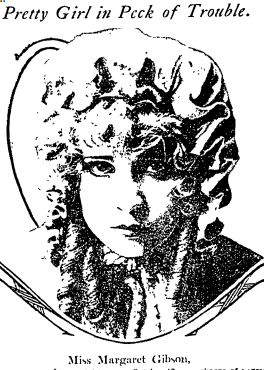
Margaret Gibson, never far from trouble
My eyes burn with tears as I write this. I do not have the deep desire but every one of their stories is molded to draw out my emotions, for their agonies and ultimate defeats.

Barbara La Marr in tears
What were the misfortunes of betrayals, the casting couches and the ultimate rejection, that caused enormous exhaustion breakdowns and the darkest of depression? These face about every screen performer. I would like to ask them all-Was it all worth it?

A sad ending for Helen Lee Worthing
But I leave it to you to decide.
You won’t know until you read how well Mr. Ankerich opens our eyes and
minds to a subject that is still a big problem over 100 years later. Congratulations
for another finely polished book with dozens of illustrations and
footnotes. I hope you find it as compelling and shattering as I did.
(Photos for this blog were selected by Ankerich)

Fontaine La Rue: Her story told in Hairpins and Dead Ends
Fontaine La Rue fascinated me for years, but she was elusive. I wanted to know what became of her and what her life was like before and after she left films. She was Dora Rogers, the Keystone Vamp, in the 1910s, and Fontaine La Rue in the 1920s. That I knew, but what became of her?

Dora Rogers
I hit a number of dead ends. But, I was on the right track. Just before pulling out the old Ouija board from the attic and calling the spirit world, I did a blog on her, Fontaine La Rue, where are you? Fontaine didn’t get in touch, but her family did!
You can now read her story in Hairpins and Dead Ends!
They adored their grandmother and great-grandmother and were eager to tell what they remembered about her. They filled in all the missing pieces and I provided some information they didn’t know.

Fontaine La Rue
One thing I learned, Fontaine was short. Just over five feet. Fontaine La Rue, I concluded, was a small woman with a big name.

She was also into the paranormal; she used a Ouija board. I located her big home in Hollywood, the one built with her “picture” money. I visited her final resting spot in Calvary Cemetery.

Fontaine’s final resting place in Calvary Cemetery
As grateful as I am to her family for telling me about their mysterious relative, I have often wondered what would have happened had I dusted off my old Ouija board and tried to contact Fontaine myself?

Hairpins and Dead Ends — Barbara La Marr’s Early Years
I featured Barbara La Marr’s life and career in Dangerous Curves. I came away convinced that her teen years were more interesting than any film she made in Hollywood in the 1920s. At least, those troubled years set Barbara on a course of self-destruction that would end her life in 1926.

A teenage Barbara La Marr
When I began working on Hairpins and Dead Ends, I knew the beautiful Barbara would make a reappearance. Unlike many sirens of the silent screen, Barbara was raised by two seemingly stable parents and her siblings play an important part in her story. I spend a lot of time in her chapter piecing together her family tree and identifying those wild branches that seemed to have delved into blackmailing and extorting wealthy paramours.

Reatha Watson (Barbara La Marr), left, and her wild and unruly half sister, Violet June (right)
Much of the chapter is constructed using Barbara’s diary from 1916 and Robert Carville’s unpublished account of his romance with the budding dancer.
You will come away feeling as though you were looking over La Marr’s shoulder as she fought with her family, abandoned sleep for the nightlife, battled tooth disease, took money from men in exchange for her company, and drank her way from one nightclub to another. I would recommend that you take a break — and a nap — after you’ve finished this chapter.

The first page of Barbara La Marr’s diary in her own handwriting
If you thought you knew everything about the “girl who was too beautiful,” get a copy of Hairpins and Dead Ends and find out the rest of the story.

Hairpins and Dead Ends: The Dedication
When it came time to dedicate Hairpins and Dead Ends, I couldn’t settle on one, so I chose two important ladies in my life, two larger-than-life characters who had perilous journeys of their own: silent film actress Lina Basquette and Carol Ankerich, my mother.

My mom has been gone over two years and the wound is still raw. She left a hole in my heart that no one will ever fill. I wrote about her illness and death in a blog, Losing Mom and Maebelle.
Here are some glamour pix of mom and me.

Here’s a glamour photograph of Lina. Now, there was a siren. My buddy, silent film historian Roi Uselton considered Lina his ideal movie vamp. She was smoldering.

Lina was my first silent film interview. I featured her in my book, Broken Silence: Conversations With 23 Silent Film Stars. She was also one who remained in my life until her death. We spent a lot of time together. In some ways, she was like a grandma to me.
When she came through the South,we’d hook up. She was the first person I saw who traveled with a portable bar stocked with her favorite liquor. Lina loved her cocktails before dinner.
At my request, she drove to Atlanta one weekend to screen one of her films and to sign her memoir. I booked her across from the Fox Theatre. She called me from her hotel.
“Michael, this is Lina. I’ve just arrived. I’m here at this dreadful Days Inn. The rooms remind me of my vaudeville days.”
“Oh, no,” I say.
“Can we find another hotel?” You bet!
We did. She was happy at the Renaissance Inn.
After the screening and book signing, Roi and I went back to her room. Lina curled up in bed and nibbled on Pepperidge Farm cookies and gossiped about this one and that until the wee hours of the morning.
Well, the stories go on and on. Someday, I will write in more detail about Lina.

Lina and Michael on a cold November morning at a Katherine’s Kitchen restaurant in Georgia.
My mother and Lina were as different as water and oil. While both were gorgeous women, Mom was very shy and reserved until she got to know you; Lina never met a stranger.
Both of these unforgettable women made a significant impression on me. I love and miss them!

The Hairpins and Dead Ends Address Book
Old Hollywood still exists, but you have to look for it. While researching Hairpins and Dead Ends, I spent a lot of time in the rat race that is Los Angeles 2017 trying to understand what it was like in, say, 1912 or 1926.
As a biographer, it is important for me to visit the homes and graves of those actresses I write about. It helps me to better understand my subjects.
What follows are some of the addresses where the actresses lived, loved and died. I have been to most of these places and I want to share them with you.
If you’re in the Los Angeles area, visit these for yourself. Arm yourself with a trusty map or GPS and a copy of Hairpins and Dead Ends. If not, the addresses and photographs take you on a personal tour through old Hollywood, where Hairpins and Dead Ends takes place.
We’re on the Hollywood Freeway heading south. Take the next exit, Highland Avenue. That puts you in the heart of Hollywood. Have fun!

Note: The addresses are in the Los Angeles area, unless otherwise noted.
Belle Bennett
2132 N. Highland (1924)
6180 Temple Hill Drive (late 1920s)

Belle Bennett’s Temple Hill Drive home
Valhalla Cemetery (final resting place)

Belle Bennett’s marker at Valhalla
Edwina Booth
1133 Fremont Avenue (1927)

Edwin Booth lived in this S. Pasadena house in 1927 (1133 Freemont Avenue)
5047 W. 21st Street (April 1930)
1948 Fletcher Avenue

Edwina Booth’s 1948 Fletcher Avenue home in the 1930s
140 Linden Avenue (last home)
1847 14th Street (Santa Monica) Woodlawn Cemetery (final resting place)
Lila Chester
306 West 20th Street, New York City (1935)
118-32 202nd, New York City (last home)

Lila Chester’s last home
61-40 Mount Olivet Crescent, Middle Village, New York (Fresh Pond Crematory, final resting place)
Virginia Lee Corbin
5154 Franklin Avenue (1917 – 1918)
1755 Ivar Avenue

Virginia Lee Corbin lived at 1755 Ivar Avenue in Hollywood
2028 Beachwood Drive (1920s)

Virginia Lee Corbin’s Hollywood home in the 1920s (2028 Beachwood Drive)
Marjorie Daw
7733 Maie Avenue (1917)

Marjorie Daw lived at 7753 Maie Avenue in 1917
8091 ½ Sunset Blvd. (1924) with Eddie Sutherland
9550 Wilshire Blvd. (Beverly Wilshire Hotel) (1930)
910 Benedict Canyon Drive (1930s) with Myron Selznick (site)
964 Palisades Beach Road, Santa Monica (1930s)

Marjorie Daw’s beach house at 964 Palisades Beach Road, Santa Monica
7151 Little Harbor Drive, Huntington Beach, CA (last house)
17772 Beach Blvd. (Huntington InterCommunity Hospital) (death place)
Florence Deshon
6220 Delongpre Avenue (1920)

Florence Deshon lived here at 6224 De Longpre Avenue
Margaret Gibson
1337 5th Avenue (Santa Monica, 1915)
432 ½ Commercial Street (location of Margaret’s arrest, 1917)

432 1/2 Commercial Street, site of Margaret Gibson’s 1917 arrest
120 South Grand Avenue (1920)
2324 N. Beachwood Drive (1923)
525 North Gramercy Place (1930)

Margaret lived at 525 Gramercy Place in 1930
1434 Morningside Court (1937)
5161 Templeton (1942)
6135 Glen Oak (last residence, location of confession)

6135 Glen Oak where Margaret Gibson confessed to the murder of William Desmond Taylor
Holy Cross Cemetery (final resting place)
Jetta Goudal
Ambassador Hotel (1920s) (site)
8320 Fountain Avenue (1930s)
875 Comstock Avenue (1972)
401 S. Burnside Avenue (1975)
1712 S. Glendale Avenue (Forest Lawn Great Mausoleum, Sanctuary of the Angels, Glendale) (final resting place)
Alice Lake
6624 ½ Hollywood Blvd. (1920) (site)
1622 Wilcox Avenue (1930)

Alice Lake’s 1930 residence (Mark Twain hotel)
6767 Yucca Street (1935)

Alice Lake lived here in 1935 (6767 Yucca Street, Hollywood)
6015 Monterey Road (last residence)

Alice Lake’s final residence, 6015 Monterey Road
2415 South Western Avenue (place of death)
Valhalla Cemetery (North Hollywood)
Barbara La Marr
1329 ½ Figueroa Street (1913)
1507 W. Pico (Faust Apartments) (1914) with Lawrence Converse

1507 W. Pico Blvd.
2408 S. Grand Avenue (Rockwood Apartments) (1914)

2408 S. Grand Avenue
822 W. 12th Street, Medford, Oregon (parent’s home) (1916)

Medford, Oregon, home of Barbara La Marr’s parents
307 W. 98th Street (1916) with Robert Carville (New York City)
1234 Boston Avenue (death house)
404 Riverside Drive, NYC (1925)
6672 Whitley Terrace (1920s)
Hollywood Forever Cemetery (final resting place)

Fontaine La Rue
709 Ceres Avenue (1912)
1802 N. Van Ness Avenue (1920s)

Fontaine La Rue’s 1920s home at 1802 N. Van Ness Avenue in Hollywood
12722 Washington Blvd. (1930)
3803 W. 8th (1930s) with Wayne Hancock
318 W. 17th Street (1938) (site)
5439 Hollywood Blvd. (1940s – 60s)
1174 North Hobart (last home)
4201 Whittier Blvd. (Calvary Cemetery, final resting place)

M Rogers Hancock (Fontaine La Rue)
Lolita Lee
1382 N. Ridgewood Place (1927)
2100 N. 49th Street, Philadelphia (last residence)
Eglington Cemetery, Clarksboro, New Jersey (final resting place)
Mona Lisa
647 S. Grand Avenue (1907) (site)
145 South Beaudry (1909) (site)
1356 S. Bonnie Brae (1926)

Mona Lisa lived in an apartment at
5101 Melrose Avenue (1932)
801 South Kingsley Drive (1940) (site)
5717 Camerford Avenue (1950)

Mona Lisa lived at 5717 Camerford Avenue in 1950
10948 Morrison (North Hollywood) (death house)
Inglewood Park Cemetery (final resting place)
Katherine MacDonald
127 North Manhattan Place (1917) (site)
Corner of Pico and Georgia (her studio in 1921)
121 S. Rossmore (home of Katherine and mother Lillian)

Katherine MacDonald built this house at 121 S. Rossmore in 1923
235 Hot Springs Road, Santa Barbara (1920s – 1956)

Katherine MacDonald lived at 235 Hot Springs Road in Santa Barbara from the late 1920s to 1956
Mary MacLaren
6541 Hollywood Blvd. (1916)
6830 Whitley Terrace (1917)

Mary McLaren lived at 6830 Whitley Terrace in 1917
127 North Manhattan Place (1917-1982) (site)

Mary MacLaren (R) sits with a neighbor on the front porch of her dilapidated home at 127 N. Manhattan Place (about 1981)
975 North Virgil (last residence)
Forest Lawn (Glendale) (final resting place)

Estrellita del Regil (the Lady in Black) weeps at the casket of Mary MacLaren at Forest Lawn in Glendale (1985)
Marion McDonald
2294 Alcyona Drive (1928-1930)

Marion McDonald lived in at 2294 Alcyona Drive high in the Hollywood Hills in the late 1920s
6561 Franklin Avenue (1940)
1443 W. 21st Street, Sunset Island, Miami Beach (last residence)
Woodlawn Cemetery, Miami, Florida (final resting place)
Evelyn Nelson
6231 Delongpre Avenue (death house – site only)

The house where Evelyn Nelson committed suicide is now a parking lot for Southern California Hospital
1831 West Washington Blvd. (Rosedale Cemetery, final resting place, unmarked)

Based on cemetery records, Evelyn Nelson rests in this unmarked grave at Rosedale Cemetery (Hollywood)
Lottie Pickford
56 Fremont Place (1920)

Lottie lived in this mansion at 56 Fremont Place with sister Mary and mother Charlotte
1001 Elden Avenue
6622 Iris Drive (1928) (scene of party)

Lottie’s Christmas Eve party house (1928)
6524 ½ Franklin Avenue (1928)
1428 North Crescent Heights (1933)
577 Burlington Avenue (death house)
Alma Rubens
1834 El Cerrito Place (1926)
1475 Havenhurst (Andalusia Apartments) 1928 (location for Alma’s wild parties)

Alma Rubens lived here, 1475 Havenhurst Drive in 1928
Intersection of N. Wilton Place to Hollywood Blvd. and in direction of Van Ness (path of Alma’s escape when she learned she was returning to the sanitarium)

Alma Rubens escaped from her home on N. Wilton when she was being committed to a sanitarium. She fled down N. Wilton and up Hollywood Blvd toward Van Ness.
1745 N. Wilton Place (1929) (site)
112 N. Manhattan (death house)

Alma Rubens died at 112 North Manhattan Place, Hollywood
Jean Sothern
Upper Octorara Cemetery, Parkesburg, PA (final resting place)
Valeska Suratt
Albany Apartments, 51st Street and Broadway, New York City (1916)
Marie Walcamp
6051 Sunset Blvd. (1914)
6113 Salem Place (1916)
1042 Sanborn Avenue (1917-1918)
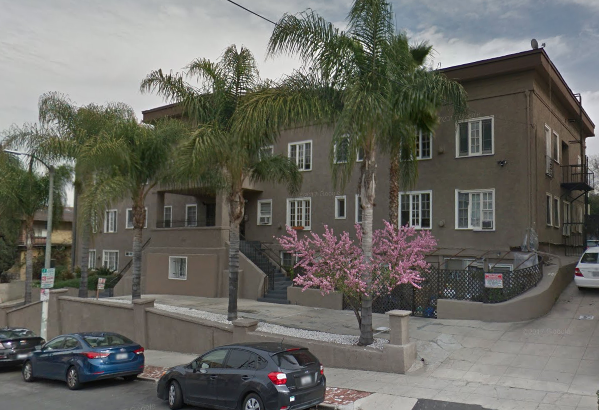
Marie Walcamp lived at 1042 Sanborn Avenue in 1917 – 1918
1014 North Vermont, Los Angeles (1919-1920)
4320 Melbourne Avenue (1930)

Marie Walcamp lived here in 1930 (4320 Melbourne Avenue)
6116 Scenic Avenue (death house)

Marie Walcamp died here at 6116 Scenic Avenue
Helen Lee Worthing
Ambassador Hotel (1926)
3439 W. 60th Street (1927)

Helen Lee Worthing’s residence in 1927 (3439 W. 60th Street)
2171 Vista Del Mar (1929) with Dr. Eugene Nelson

Helen Lee Worthing lived at 2171 Vista Del Mar in 1929
Intersection of Sunset and Portia Street (Helen found here passed out, 1946)

Helen Lee Worthing was found passed out at this intersection (Sunset and Portia) in 1946
1062 North Serrano Avenue (death house)
Inglewood Park Cemetery (final resting place)

Hairpins and Dead Ends: The Girl on the Cover
By Michael G. Ankerich
After the title Hairpins and Dead Ends came to me, there was only one photo destined to be the cover. Edwina Booth with her hair in pins. Well, maybe they aren’t supposed to be hairpins, but you get the picture.

Edwina survived a mysterious illness she contracted while on location in Africa for Trader Horn (1931). The beautiful blonde was never the same. She soon vanished from the screen and public view. Many believed she had succumbed to her disease. Comfortable in her seclusion, Edwina never came forward to prove them wrong.
She was one of the actresses I sought for an interview in the 1980s. It was impossible. She would speak to no one about her career and illness.
While researching Hairpins and Dead Ends, I contacted her cousins and nieces who told me the real story behind Edwina’s life, particularly her later years and marriages.
Edwina Booth is featured in Hairpins and Dead Ends.

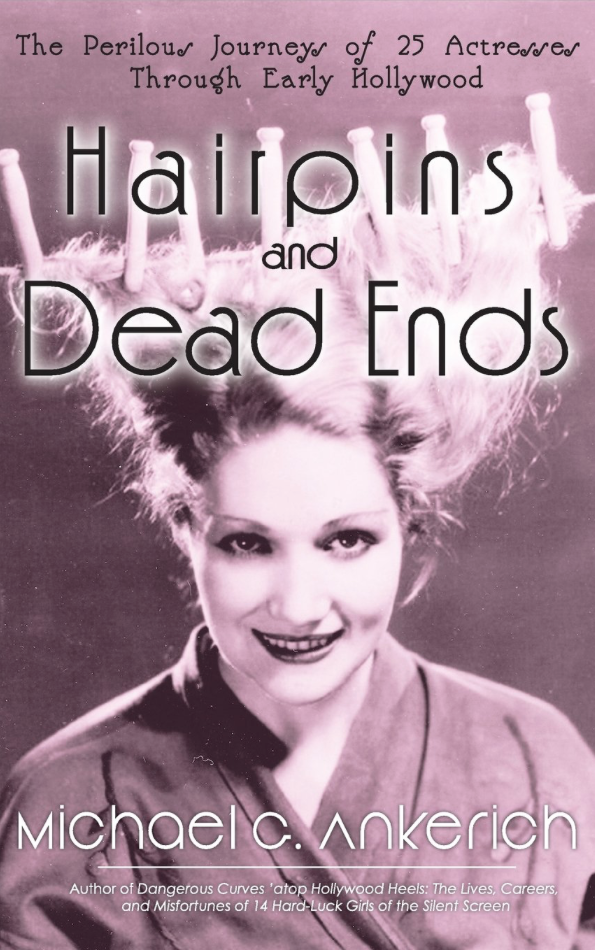
Hairpins and Dead Ends is Waiting! Are You Ready for the Journey?
You survived Dangerous Curves ‘atop Hollywood Heels, my 2011 book about ill-fated actresses of the silent screen . . .
. . . but are you ready for the companion book, Hairpins and Dead Ends: The Perilous Journeys of 25 Actresses Through Early Hollywood? Get ready! It’s here.

My new book takes you on a hair-raising rollercoaster ride through a time when Hollywood was surrounded by orange groves, not concrete jungles, and into the intimate lives of 25 beauties, ambitious nobodies who wanted to be somebodies.
Several became twinkling stars, while others settled as serial queens, slapstick vamps, bathing beauties, western heroines, and everything in between. While many young hopefuls abandoned their quest for fame and returned home disappointed, here are the stories of women who stayed, often to a bitter and tragic end brought on by drugs, booze, and suicide.
Through my intensive research, which includes interviews with relatives of the actresses, I’ll take you into the dark side of Tinseltown, a world of dope rings, whorehouses, gin joints, and other gritty hellholes some called home.
Lavishly illustrated with over 160 photographs, many from family scrapbooks, Hairpins and Dead Ends uncovers a world that offered passion and imagination, but functioned on illicit love, domineering mothers, desperation, greed, abuse, and discrimination.
The screen images of these 25 dazzling beauties were fleeting shadows. Their personal passions and struggles in real life held more drama than any role they clamored to play. These ladies make up the ghosts of Hollywood’s past.
Ready? Let’s go!


A Visit With Actress Margaret Lindsay
Michael’s Note: Lenore Heidorn was the president of Billie Dove’s fan club in the early 1930s. A Chicago native, she made lots of visits to Hollywood to meet her favorites. Here is her story about meeting Margaret Lindsay. Enjoy.
By Lenore A Heidorn
The highlight of my recent visit to sunny California was my meeting with the charming Warner Brothers actress, Margaret Lindsay. I had long admired her and had written numerous letters, but had never received any reply, so I was doubtful as to whether anything would come of my letting her know that I would be in Hollywood soon, and that I would like to see her.
Upon our arrival in Hollywood, our first stop was at the home of Millie Wist, whom I had asked Margaret to contact if she would like to see us. Millie told us that Margaret had called Tove Blue (Monte’s charming wife), a mutual friend, twice to see if we had arrived. To cut short the preliminaries, Millie arranged to have Margaret meet us for cocktails at her home the following Tuesday.

Lenore (right) with Margaret Lindsay (center) and Tove Blue at The Tropics, Beverly Hills, about 1939.
The time of our meeting finally arrived. I was quite jittery because I had heard so much about Margaret being high-hat and aloof, but how decidedly untrue this is. I found her to be one of the loveliest, friendliest people I had ever met out there. Over our Cuba Libres, we had a grand visit. I found that she had read my letters, for she constantly referred to many things I told her in them. Margaret was working at the Columbia studios in There’s That Woman Again with Melvyn Douglas and Virginia Bruce, and had recently completed Garden of the Moon with Pat O’Brien and John Payne.

Knowing that I worked in the long distance office of the telephone company, she asked me if we ever listened in on conversations. I said that we were not supposed to, but occasionally we did. Then she told me of the time she had just been awarded a good role in a picture and had called her mother in Dubuque (Iowa) to tell her the good news. She was surprised when her mother wrote her later and told her that a few minutes after her call, people began calling her to congratulate her! I attributed that to the smallness of the Dubuque office, as I told her we didn’t have time to listen in. We were too busy, besides it being against the rules.

We visited for almost two hours, and when she left, she asked me where we were staying so she could phone me before we left. We had a long conversation on Saturday, and I was amazed when she told me she had been “scared to death” to meet me. About an hour after I talked with her, Halchester’s delivered my sister and me each a beautiful gardenia corsage with a card reading, “In remembrance of our meeting, Margaret Lindsay.”
So after all my waiting, I found Margaret to be just as I had always imagined her . . .beautiful, cultured, and most of all, friendly and sincere.
You Made It! Happy Birthday, Olivia!
Happy 100th to a true legend, Olivia de Havilland!

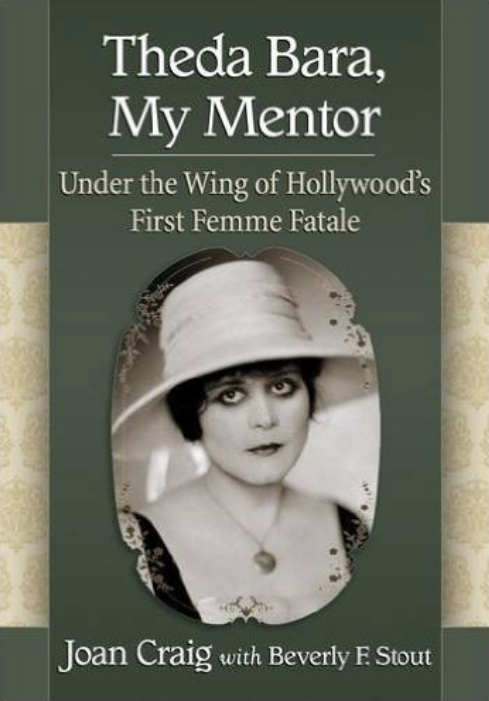
Author Joan Craig Shares Her Memories of Theda Bara in New Book
Theda Bara, My Mentor: Under the Wing of Hollywood’s First Femme Fatale by Joan Craig, with Beverly E. Stout, is the book that I have been waiting for. They don’t come along everyday, these intimate and personal recollections of someone who actually knew the silent film greats, but when they do, they have my attention.
I was delighted that Joan agreed to talk with me about her new book. Read on . . .
From the back cover of Theda Bara, My Mentor:
As movie patrons sat in darkened theaters in January 1914, they were mesmerized by an alluring temptress with long sable hair and kohl-rimmed eyes. Theda Bara—“the vamp,” as she would come to be known—would soon be one of the highest paid film stars of the 1910s, earning an unheard of $4,000 per week, before retiring from the screen in 1926.
In 1946, the author met Bara-then 61-at her Beverly Hills home and the actress became her mentor. This memoir is the story of their friendship.

Michael: First of all, tell me a little about yourself.
Joan: I attended Westlake School for Girls (now Harvard-Westlake School) in Holmby Hills. I graduated from Marymount High School, West Los Angeles. I attended Marymount-Loyola and UCLA. I raised my daughter in Newport Beach, California. We moved to New York City while my daughter attended The Professional Children’s School. I am currently retired and living with my husband Kurt Ruch.

Joan Craig
Michael: Set the stage for us. Tell me about your childhood and how you got to Beverly Hills.
Joan: I was the only child of my parents’ marriage. I was born during World War II. My father was starting his own oil company on the West Coast at that time. My father had built one of the first gas stations in Las Vegas. During that time I grew up in the back seat of a car and staying at the finest hotels such as El Rancho Vegas, Mark Hopkins, Fairmount, Bel-Air Hotel, The Beverly Hills Hotel and others. My parents settled in Beverly Hills, when my father decided to build the largest gas station in the world with 24 pumps on Wilshire Boulevard in Miracle Mile in 1946.
Michael: How did you come to live on Alpine Drive, Theda’s street?
Joan: My parents first rented a house owned by Adolf Spreckels II, the sugar king heir, located at 729 North Alpine Drive across the street from Theda. I was on my way to my first day at school with my nanny, when Charles Brabin (Theda’s husband) cut a rose from his garden to take to my teacher that day.

Theda’s home in earlier days

Theda’s home today. Joan lived in the house across the street. In this photo, Joan’s house is just above the stop sign.
Michael: What was the address of her house?
Joan: Theda’s house was 632 North Alpine Drive. Ours was 702 North Alpine Drive, Beverly Hills, which was directly across the street from Theda.
Michael: Who were some of your other neighbors? Anyone we might know?
Joan: Ben Hecht who was known as the Shakespeare of Hollywood lived directly behind us. Harold Adamson, a song writer, who was known for writing Around the World for Eighty Days, I Love Lucy, Frank Sinatra’s first Academy Award nomination I Couldn’t Sleep a Wink Last Night and others. Dean Martin moved into 729 N. Alpine Drive after we vacated it, then Jerry Lewis. The dance team Veloz and Yolanda lived in a house in the middle of the block behind us on Foothill Drive. Across the way from that house lived Thurston Hall who played Antony in Cleopatra. In the 600 block on North Alpine lived Norma Talmadge.

Theda and her crystal ball
Michael: Do you remember the first time you met Theda. Tell me about it.
Joan: I was on my way to school and in passing Mr. Brabin in his garden, I was told that the lady in the house would like to meet me. Upon entering the house I was ushered into the living room. Theda Bara entered the room and asked me to sit down. She sat on a sofa with a crystal ball covered with a cloth in front of her on the table. She asked me many questions while she looked under the cloth at the crystal ball. After meeting her, I felt that I had met someone with a very special gift! She told me to be very good because she could see everything.
Michael: What did you call her? Mrs. Brabin?
Joan: No, I called her Aunt Theda.
Michael: Incidentally, how do you remember her name being pronounced? Like “Theeda”?
Joan: Some called her that but she preferred like “Thayda”.

Michael: What was her physical appearance like? She actually kept her hair rather long, didn’t she? We think of Theda with white face powder and black kohl around her eyes.
Joan: Yes, she kept her hair long. Theda processed her makeup in her kitchen. However, at that time in her life, she did not wear very much makeup.
Michael: As I understand it, she became a gourmet cook. Did you ever dine with her?
Joan: I dined with Theda many times. She liked to cook. She also had a British cook.
Michael: Did she talk about her days in silent film and making movies?
Joan: Yes. Sometimes we would go to the location where a film had been made. She and Charles would re-enact a special scene from that film as I read the story.
Joan: One of Theda’s favorite subjects was psychology. She was proud of her films since many of them exposed character personalities that may be devious. She felt the insight was beneficial to the public at that time.

Theda in later years
Michael: How did that impact her work in films, do you believe?
Joan: Theda was so good at portraying her characters, people really believed that that likeness was her in real life. This was a sensitive issue for Theda. She was not anything like the characters that she portrayed.
Michael: We think of Theda as very dramatic, over the top, perhaps a Norma Desmond type. Did she come across as being eccentric or egotistical?
Joan: Theda was neither eccentric nor egotistical. She liked having many of the props from her movies around her in her house. Some of them were unusual. She had many friends, mostly celebrities. She loved to entertain and had many parties. She was very sweet, always concerned about the other person.

Theda and Charles Brabin
Michael: Tell me about Charles Brabin, her director husband.
Joan: Charles Brabin was a highly principled man. He and Theda had a very happy marriage. They shared much of the film industry together.
Michael: Do you remember what he called Theda?
Joan: They called each other “Moody”.
Michael: You gave me a insightful anecdote about Theda and Mae Murray for my biography on Mae. Do you remember seeing others visit her from her era? Who were they?
Joan: Most Hollywood stars came to her, too many to list here! Her close friends were from her era. Marion Davies adored Theda. They would have lots of laughs together.

Theda and Mae Murray
Michael: Theda took a real interest in you as a child. What was her relationship to other children in the neighborhood?
Joan: She seemed to like children very much, but didn’t have any of her own. Very interesting! Neither did her sister have children. I think that I was the only child allowed in her house. She and I had a very special relationship. I wanted to move into their house and told them that I could eat across the street so that I wouldn’t cost very much.
Michael: You mention she was a mentor. How was that?
Joan: Theda oversaw most of my lessons. She attended my school functions. I learned math quite quickly. She told me that I could read my fortune in the newspaper providing I could add up my numbers correctly! Both Theda and Charles taught me that it was important to have obtainable goals and good principles.

From the collection of Michael G. Ankerich
Michael: Did she have a lot of photographs of herself around the house?
Joan: A few photos that were more portrait type.
Michael: Did she give you any autographed photographs of herself?
Joan: No, she gave me her personal photo album and some of her costumes.
Michael: Is it true that Theda didn’t like candid photographs taken?
Joan: Candid photos of Theda were not allowed. During the forties and fifties, celebrities only allowed professional photos of themselves. If photos were taken they were torn up so that they could not be used in an unfavorable manner.
Michael: You mother didn’t mind that we went over to the Brabin house, but she didn’t want you to have your photograph taken with Theda.
Even in the late forties, some people shunned Theda Bara. Women were still afraid that she might take their husband! My mother told me that a photo with Theda Bara might affect my future life.
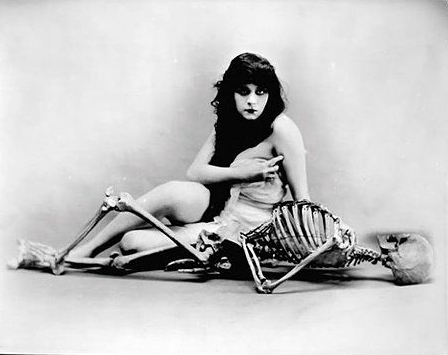
Theda and her prey
Michael: From what I gather, she was someone who lived in the present, interested in present day events, not one to live in the past. Am I correct?
Joan: Yes. While they didn’t live in the past, Theda and Charles enjoyed sharing their life experiences with me.

An older Theda Bara
Michael: Do you remember the last time you saw her? Was she ill at that point?
Joan: The last time that I saw her was a few days before she died.
Michael: Did you ever meet Theda’s mother. I believe her name was Pauline.
Joan: Yes, I meet her many times. She was an elegant appearing woman. She declined to learn English. She spoke several other languages. She and Theda would speak conversational Latin with me at the dining room table. Her native language was Francoprovencal French. This was a native dialect of Switzerland.
Michael: She outlived Theda by two years.
Joan: After Theda passed away, she moved into Westwood, in West Los Angeles, with her daughter Lori. She developed Alzheimers and soon passed away.

An autographed photograph of Theda Bara. Collection of Michael G. Ankerich
Michael: Did you see much of Charles Brabin after Theda’s death?
Joan: My Mother and I oversaw the care and burial arrangements of Theda’s mother and Lori, her sister. We frequently looked after Charles Brabin and made his funeral and burial arrangements. This left me with a deep sorrow in my heart. The loss still brings me tears.
Michael: What do you want readers of your book to come away with?
Joan: An understanding of Theda in her personal life. Although she was retired, she was very much a part of Hollywood all during her life.
For more information, refer to Theda Bara: My Mentor and the McFarland website.
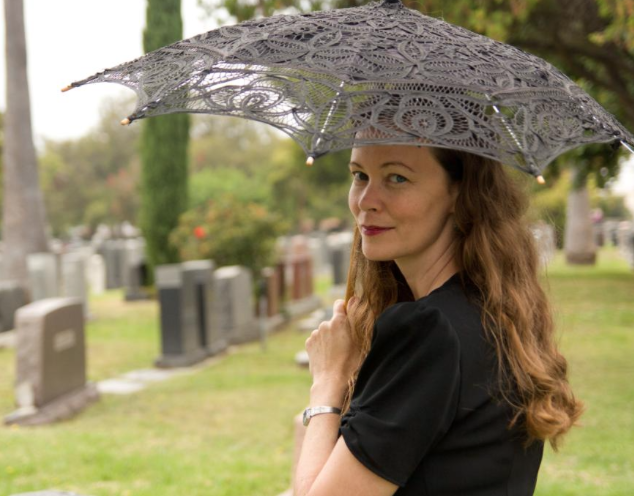
Life is Good at Hollywood Forever: A Chat With Karie Bible, Tour Guide
If you know me at all, you know I like to hang out in cemeteries. I’ve haunted graveyards all over the world, but my absolute favorite is Hollywood Forever Cemetery. In the middle of crowded and congested Hollywood, it is a haven of rest, for sure, but also a lovely park and a place to spend some quiet time with the Hollywood greats.
The truth is, friends, I’d rather be here than at Universal Studios or Disneyland — any day!
When I’m in Los Angeles researching a book, my pattern is pretty much the same. I have breakfast at Denny’s on Sunset and Western, then head down to Hollywood Forever to walk around and let the bacon and pancakes settle. Then it’s off to the Academy Library for a day of research.

In 2013, I was a guest speaker at the annual Valentino Memorial Service at Hollywood Forever. I was so excited to meet Karie Bible, a devoted film historian who leads the Hollywood Forever Cemetery Walking Tour. As I figure it, she just about has the coolest job imaginable.
Let’s find out!

Karie Bible
Michael: How long have you been tour guide at Hollywood Forever?
Karie: I’ve been giving tours several times a month since February 2002.

Michael on his first visit (with Charlene) to Hollywood Memorial (now Forever), about 1986
Michael: My first trip to Hollywood was in the mid-1980s. Then it was Hollywood Memorial Cemetery and was among the first places I wanted to see. When was your first visit and what were your first impressions?
Karie: When I first visited the cemetery, I was pretty emotional. A co-worker of mine had recently died at a young age and I was very upset about it. When I walked into the gates of the cemetery, I looked around and my mood started to change. I didn’t see the place as sad or morbid. To me it was a peaceful, beautiful oasis and a place to celebrate life. I fell in love with it immediately.
Michael: On that first visit, I was interested in one person: Valentino. Of course, I saw Barbara La Marr, William Desmond Taylor, and Marion Davies. But there really is so much more to see, isn’t there?

A selfie at Valentino’s crypt, about 2014
Karie: There are tons of things to see! There is a story behind every single grave there. The cemetery has beautiful architecture, unique headstones and hosts a ton of creative people.
Michael: Tell me some of the highlights of your tours. Have you made any surprise discoveries?
Karie: One of my favorite things is seeing the look of joy and excitement that people get when they see the grave of a star that was meaningful to them. One day I was giving a tour and speaking to a large group about Valentino.
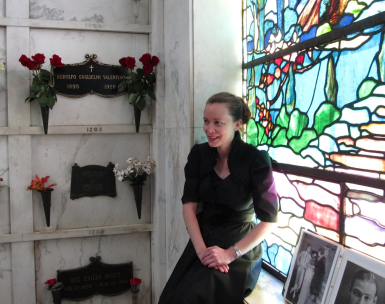
Karie at Valentino’s crypt
There was a girl in the group who was about 20 years old. When I started talking about Valentino’s life, tears began pouring down her face. She finally turned around and ran out of the building. I was a bit shocked and couldn’t imagine what I could have said to upset her. I asked her boyfriend if she was ok. He said, “She just gets very emotional about Valentino.” It is a pretty big testament to his charisma and star power that ninety years after his death young girls still cry and react emotionally at his grave.
On another day I had an elderly lady who actually taught Jayne
Mansfield’s children. She said that there were many celebrity kids at
the school, and that Jayne was the ONLY famous parent who ever showed up
in person. 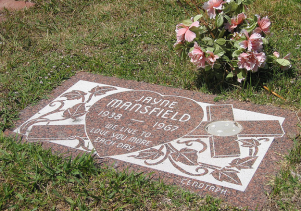 She
said Jayne was active at the school and a really loving, caring mother.
That was a beautiful story and certainly makes her seem much more
human. While these people may be icons, sex symbols, etc. they are, in
fact, people.
She
said Jayne was active at the school and a really loving, caring mother.
That was a beautiful story and certainly makes her seem much more
human. While these people may be icons, sex symbols, etc. they are, in
fact, people.
Michael: What questions do you get most from those taking your tour?
Karie: People often ask me about the peacocks and many of the graves with the faces etched into the marble. Those things add so much character to the place.
Michael: Yeah, I want to get to the peacocks in a minute. Any estimate as to the number of tours you’ve given?
Karie: I couldn’t even begin to tell you. I do about two or three tours a month and it has now been 14 years. That isn’t counting private tours, the special art deco tour and other things.

Karie in tour!
Back in 2013, I started getting kidney stones right before I gave a tour. I didn’t want to let the people down who had booked and I figured that the show must go on! I gave a 2 ½ hour tour with massive kidney stones. I was in so much pain that I really don’t remember very much. I have done the tour so many times that I sort of went on autopilot. I was rushed to Cedar’s Sinai right afterward.

Johnny Ramone’s monument
Michael: What’s the most unusual monument or tombstone?
Karie: None of them seem unusual to me, but I think that Johnny Ramone’s grave seems to draw a lot of attention. I’ve given many tours to seniors who don’t even know who he is, but that can’t stop looking at his grave.
Michael: On a recent tour, I was looking for the grave of Mae Murray’s brother. I was almost attacked by a gigantic peacock. I’ve since seen their cages. I have to admit they are beautiful creatures. What’s the story behind them and their home at the cemetery?
Karie: Someone told me that the peacock is a symbol for eternal life. That would make sense because cemeteries are always filled with symbolism and nothing is just there arbitrarily. If you look near the flower shop, there are peacocks in the stained glass and even peacock feathers painted on the dome over the building.

Watch for the peacocks; they have the right of way!
Michael: What’s the story around the big, black car that sits up front?
Karie: That is an antique hearse that the owner Tyler Cassity purchased. I think it is from 1939. As far as I know it still works and is put to use.

Michael: Are there any unmarked graves of silent film stars there? I believe Florence Lawrence’s grave was once unmarked, but she now has a marker.
Karie: Yes there are still unmarked star graves. Getting a marker can be a complicated process that involves getting permission from the family (if there are any still alive) and raising money. The cemetery has been great about helping make that process happen. I know that silent comic actor Ford Sterling was recently marked and Ann Sheridan was as well. Tyler and his staff recently got a marker for the grave of Pauline Pfeiffer Hemingway, Ernest Hemmingway’s second wife. Historian Allan Ellenberger does an excellent blog about Hollywood history and written about it. http://allanellenberger.com/sins-of-the-mother-the-story-of-pauline-hemingway/
 Michael: Have all the film related graves, niches, and crypts been identified?
Karie: To my knowledge, yes they have been identified.
Michael: Are there any missing old timers that may be there?
Karie: Not that I know of. I always preface things by saying that, as you never know!
Michael: What mysteries are there? What are your favorites?
Karie: The grave of William Desmond Taylor would count as a mystery. It is one of the most famous unsolved murders in Hollywood history. There have been so many books about it, but I think it will always remain a mystery.

William Desmond Taylor
I love Valentino, but I feel a deep connection to all of the people there. I spend a lot of time at the cemetery and I’m very passionate about film history. There are so many pioneers buried at Hollywood Forever who were at the ground floor as the art form and business of Hollywood was being created. Many of them worked behind the scenes as writers, cinematographers, composers and crew.
Michael: I understand. My passion is researching the lives of those from the very beginning.
Karie: So many of these people go unappreciated. A great number of them were discarded and forgotten. They deserve better.
Michael: Have you ever met any relatives of some of the permanent residents of Hollywood Forever on your tour? Who were they?
Karie: Several years ago, I was giving a small tour and as I was at J ohn Huston’s grave. I turned around and Angelica Huston was standing right there.
She was cleaning up the flowers and grass around her father’s grave. I
didn’t want to bother her, but she was very gracious and a total class
act.
Michael: If you were an early actor or actress died in Hollywood, what choices did you have? Rosedale, I know. What others?

Karie: Hollywood Forever (originally named Hollywood Memorial Park) was founded in 1899. Forest Lawn Glendale came along in 1906. Calvary Cemetery was established in 1896 and Evergreen Cemetery in 1877. I think that Home of Peace has been in their current spot since 1902. Grand View Memorial Park dates back to 1884. I’m sure there are others I’m forgetting, but those are the ones that come to mind.
Michael: Are there any haunted areas of the cemetery that you are aware of? Tell me the stories.
Karie: People often ask me that question. I’ve been there a long time
and I’ve never had a paranormal encounter of any kind. There have been
rumors that Clifton Webb walks down the corridor of the Abbey of the
Psalms Mausoleum or that you can hear actress Virginia Rappe weeping.  To me, the history is fascinating enough and I really don’t want to focus on the paranormal. (By the way, read Room 1219 to
learn more about Virginia Rappe, the actress who died after the party
thrown by Roscoe “Fatty” Arbuckle. It is an excellent read!)
To me, the history is fascinating enough and I really don’t want to focus on the paranormal. (By the way, read Room 1219 to
learn more about Virginia Rappe, the actress who died after the party
thrown by Roscoe “Fatty” Arbuckle. It is an excellent read!)
Michael: So, give the cemetery a little plug for my readers? Invite them to take the tour!
Karie: The “Cemetery of the Stars” tour at Hollywood Forever is a great overview of the cemetery. It includes the big names including Rudolph Valentino, Cecil B. DeMille, Marion Davies, Tyrone Power, Vampira, John Huston, Johnny Ramone, Peter Lorre, Mel Blanc and many more! Hollywood Forever is a beautiful place and one of the most unique cemeteries in the world! Learn more about dates and times for the tour at www.cemeterytour.com.

Watch for these beautiful birds

A stunning view of the Hollywood Sign awaits as you exit the cemetery.

Billie Dove and the End of a Nagging Question
It was one subject I couldn’t bring up to Billie Dove. What I wanted to ask was, “Billie, how old are you?” Well, I would have never asked it in those exact words. But I wanted to clear up the question of her year of birth. To a researcher determined to set the record straight, asking those questions is critical, especially when film reference books cannot agree on one date.

“To you, Lenore (her fan club president), from me.”
One can use the tactic of bringing up the most sensitive questions until the end of the interview. That way, you have the story in case they hang up on you and show you the door the moment the question rolls off your lips. But I couldn’t ask it then, either.

Billie and husband Bob Kenaston
I didn’t have to. Billie addressed the subject herself near the beginning of our first interview.
“I simply don’t believe that the number of years a person has lived is how old they are,” she said to me. “Two people, exactly the same age, can be entirely different. It’s what you have absorbed that counts.”
Fair enough.
I kept digging. The film reference books were all over the board on the question. They had Billie being born from 1900 to 1904. Katz’s The Film Encyclopedia suggested 1900 as Billie’s year of birth. Her fan club president told me 1900 was the date. Billie’s maid had found the birth certificate when going through some papers.
Dewitt Bodeen’s excellent career article on Billie for Films in Review suggested 1901. The 1920 U.S. Federal Census indicated 1903.

Billie and Michael
When The Sound of Silence, the book that included the lengthy interview I did with Billie went to press, I played it safe. I presented the possibilities as I had uncovered them and put the information out for the readers to decide.
When Billie died, the mystery was still unsolved. Her obits indicated 1900 and 1901. Her death certificate gave 1901. In her 1954 application for a Social Security Number, Billie gave 1903.
Billie’s words came back to haunt me, “Even my husbands didn’t know how old I was,” she once said.
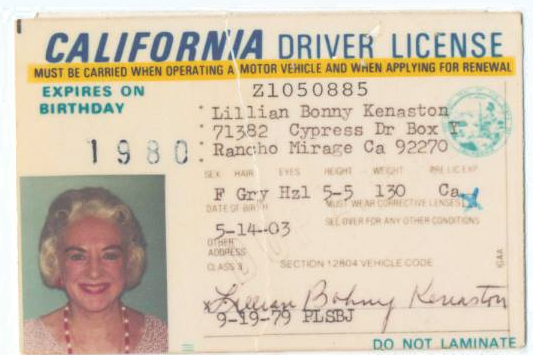
Last week, I was delighted to hear from Paul Melzer through Facebook, a reader who has acquired Billie Dove’s driver’s license and birth certificate. With his permission, I am sharing them with you.
One more mystery solved. Researching for the facts becomes obsessive. See how much fun we have!
Anyway, Billie Dove, according to her birth certificate was born May 14, 1903. Now we know. Everyone breathe a sigh of relief. Slow exhale.
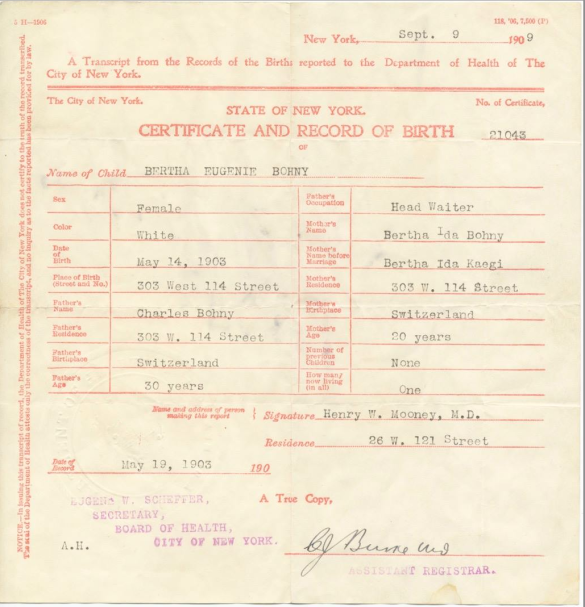
Billie’s birth certificate (Courtesy of Paul Melzer)
Take a look at her California driver’s license from 1979.

Michael G. Ankerich: The SVM Interview
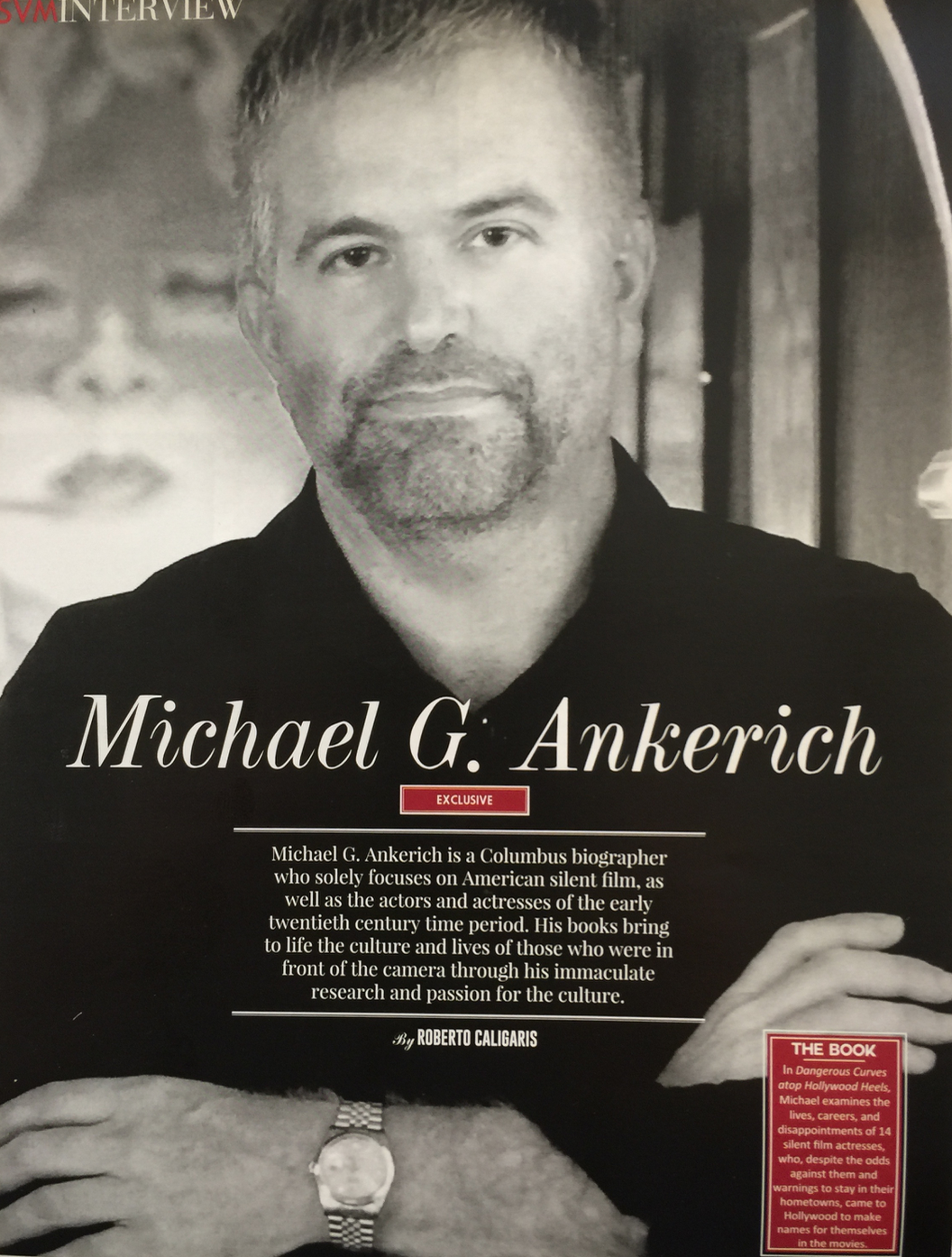
I was delighted to be interviewed for the February/March issue of Southern Views Magazine (SVM). For those of you who may not have access to the publication, I am providing some of what we discussed in this blog.
You have been writing books about American silent film and early twentieth century actors and actresses for the last couple of decades now. What made you decide to write about this period and genre?
I was fascinated by the silent film era as a teenager and it was pure curiosity that prompted me to focus on that era. I simply wanted to know more. This was in the mid-1910s, a long time before the Internet. The curiosity I had led me to a dead end where I realized that the information I was looking for was still unwritten. I delved into my own research and, eventually, I wanted to share what I had learned and discovered.
During your investigations for the books you wrote, did you have the opportunity to meet personally with any of the actors or actresses, and if so who were they, what kind of unique treasures and memorabilia did they share with you?
When I began my research, there were a number of the actors and actresses still alive from that period, the 1910s and 1920s. My first objective was to make contact with those who had been there and worked at the period. I spent the next 15 years or so traveling back and forth to the West Coast and interviewing those fascinating individuals and recording their memories before the passage of time took away their stories.
Those interviews became the basis for my first two books: Broken Silence: Conversations With 23 Silent Film Stars (1993) and Broken Silence: Conversations With 16 Film and Stage Personalities Who Made the Transition from Silents to Talkies (1998).
They were quite generous in sharing their portraits and movie stills with me for the books.

Hard to believe that Muriel Ostriche started her career in films in 1912.
I interviewed Muriel Ostriche, whose career in films began around 1912. I interviewed Maxine Elliott Hicks, who made her first film in 1914 and was still making films when I talked with her in 1990. I talked with some (Ethlyne Clair, Mary Brian, Anita Page, and Hugh Allen come to mind) who had not spoken that extensively about their careers since their retirement.
Douglas Fairbanks Jr. talked about working in the shadow of his famous father (Doug Sr) and his relationships with Mary Pickford, his stepmother, and Joan Crawford, his first wife.

Billie Dove
Billie Dove, once referred to as the Elizabeth Taylor of the 1920s, vowed over the phone that she would not answer questions about her romance with and engagement to millionaire Howard Hughes, but by the end of our conversation, she had invited me out to her home in Palm Springs to tell me the fascinating details of their relationship.
While they were silent film stars, they were anything but silent when I talked with them. Their stories would make you laugh, cry and gasp!
One of your masterpieces is Dangerous Curves atop Hollywood Heels: The Lives, Careers, and Misfortunes of 14 Hard-Luck Girls of the Silent Screen. What made you write this book?
Dangerous Curves was a departure from my first two books, in that the stories were not based on interviews with the subjects but on research, archives, and family interviews. I selected the subjects not because I was expert on them, but because I wanted to know more.

Eve Southern
I choose 14 actresses from that era who had relatively difficult experiences in their careers. I traced their precarious routes through fame and uncovered how some of the top actresses of the day were used, abused, and discarded.
Many who read my books like Dangerous Curves best.
It has certainly opened up new avenues for me. It led to several
speaking engagements and my television debut on a Lifetime Movie Network
series, The Ghost Inside My Child, in 2014.
One of your latest works is based on the biography of silent film actress Mae Murray. Why her and what does she mean to you?
First of all, Mae Murray was everything a movie queen in the days of silent films was expected to be: extravagant, vain, eccentric, egotistical, and temperamental.

She was a biographer’s dream. There was much of her life I knew, some I thought I knew, and areas I didn’t know at all.
Mae’s life was truly a rags-to-riches and back-to-rags story. She escaped a childhood marred by poverty and alcoholism, divorced her family, and was reborn as a Ziegfeld Follies showgirl in the mid-1910s. In Hollywood, she became a huge movie star, but at the height of her fame, walked out on her $7,500-a-week film contract.

Mae and her prince, David Mdivani.
She married one of the “marrying Mdivani” princes who turned out to be a phony. She fled to Paris, became a mother, and returned to Hollywood only to be blackballed by her enemies. By the time Mae divorced her prince, her $3 million fortune was little more than pennies. Exhausted after countless legal battles and one-night stands on the road in vaudeville, she slept on park benches in New York’s Central Park. For the rest of her life, this poor woman fought poverty but continued to live in a fantasy world where time had not passed her by.
So, as you can see, her life read like a movie script, but it was real life for Mae Murray. I could not have asked for a better subject!
Is there one particular silent film star that you are more fond of and why?
I am infatuated with Greta Garbo as an actress and screen personality. Her beauty is breathtaking. After spending more than two years researching her life and career, I also developed a genuine fondness for Mae Murray, if for no other reason than her will to survive. Lon Chaney, a master of disguises, is also up there on my list.

Mae waving goodbye to her fans
Are there any classic films that you like to watch over and over?
Although she wasn’t from the silent film era, Bette Davis is my favorite film actress of all time. I can watch Now, Voyager and All About Eve over and over. Any Bette Davis film, for that matter!
How does the artistic value of a silent, classic film culture compare to the artistic value of today’s film culture?
Lillian Gish, the first lady of the silent screen and an advocate for silent film preservation until her death, said it best. Silent films were the marriage of film to classical music. It was during this era that films spoke a universal language, meaning they were done with action and music, not words. Part of the message is lost when a film’s plot depends on words and has to be translated into the language of every country where it is shown.
Silent films are generally misunderstood today because the clips people see are poor quality prints projected at the wrong speed. It is extremely unfortunate because the jerky motion and speed of projection give the impression that all silent films were bad slapstick.
Are you currently planning and working on any future projects or books?
I’m in the middle of writing my new book, Hairpins and Dead Ends: The Perilous Journeys of 20 Actresses Through Early Hollywood. It’s a companion volume to Dangerous Curves atop Hollywood Heels. I have several other book ideas floating around, including a spiritual autobiography. There’s also a speaking engagement and book signing in the works for Los Angeles later in the year. So things are percolating right along!

Bob Harned Remembers His Mother, Actress Sally Phipps
If you ever wondered what became of silent film actress Sally Phipps, you’re in luck. Bob Harned has written a thorough and revealing biography of one of the cutest flappers to ever grace the silent screen. Bob is not just any writer; he just happens to be her son!

Sally Phipps
A little about Sally and then I will introduce you to Bob and bring you into the conversation we had about his book, Sally Phipps: Silent Film Star.

Her real name was not Sally Phipps, but Nellie Bernice Bogdon. When she came to Hollywood and signed with Fox Studios, she became Sally Phipps, a name that seemed to fit a care-free Jazz baby.
Sally was born in 1911 in Oakland, California. A brother, Lane, came along in 1913. Her father, Albert E. Bogdon, was a professional magician and quite easy on the eye (He later became a lawyer). Her mother, Edithe, a commercial artist, later worked at First National Studios coloring black and white photographs.
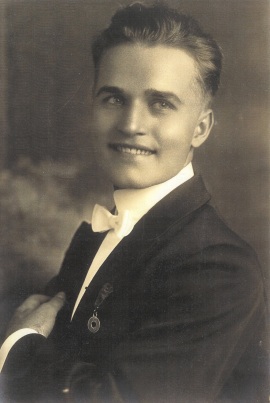
Sally’s father, Albert E. Bogdon
When Albert and Edithe’s marriage fell apart, Sally went to live with her maternal grandmother, Nellie Lane. When she was not quite two, Sally was placed with a foster family, Warren and Eva Sawyer. Warren and Eva were employees at Essanay Film Corporation in Niles, California.
Sally’s career began as Bernice Sawyer at age four when she made three Broncho Billy films at Essanay: Broncho Billy and the Baby, The Western Way, The Outlaw’s Awakening, all 1915 releases.

Sally in about 1915
A stagecoach accident ended Sally’s career at Essanay and sent her back to Nellie, her grandmother.
Edithe, Sally’s mother, began a new life in the 1920s and wanted Sally and Lane to be part of it. Edithe married Albert Beutler in 1922. In 1924, The family moved to Los Angeles.
Danny Borzage, a family friend, saw potential in 14-year-old Sally. Danny’s brother Frank, a director at Fox, gave Sally a screen test and the rest, as they say, is history.

Sally and Danny Borzage
After several uncredited roles, Sally began playing leads. The studio considered her image as that of a happy-go-lucky flapper and used her in comedies, often opposite Nick Stuart.
Sally was named a Wampas Baby Star in 1927, along with Patricia Avery, Rita Carewe, Helene Costello, Barbara Kent, Natalie Kingston, Frances Lee, Mary McAlister, Gladys McConnell, Sally Rand, Martha Sleeper, Iris Stuart, and Adamae Vaughn.

Wampas Baby Stars of 1927. Sally is pictured second from the left. How many others can you name?
In 1928, while filming None But The Brave with Charles Morton, , Sally developed the dreaded Klieg Eye, a eye irritation caused by the powerful lights used on studio sets.

A scene from None But The Brave with Charles Morton (R)
After her recovery, Sally went on vacation. She was away from the cameras for nine months, an eternity in filmdom.
Nick Stuart was soon making films and making out with Sue Carol. The actress grabbed onto Nick and wouldn’t let go. They were married in 1929.

Sue Carol and Nick Stuart (Michael G. Ankerich Collection)
In March 1929, 17-year-old Sally sued her mother and stepfather for the misuse of her money — she was earning $225 a week.
Soon after, Fox dropped Sally from its rolls. She tried Broadway, appearing as a starlet in the Moss Hart-George S. Kaufman hit Once in a Lifetime.

Sally onboard the Ile De France in 1933
I will save the rest of her life for your reading pleasure. In short, she was briefly married to a Gimbel department store. By the mid-1930s, Sally was living in a one-room apartment in Manhattan and making $25 a week as a secretary.
She lived in India for a time and studied Eastern religions. At a séance, she met Alfred Harned, whom she married in 1941. A daughter, Maryanna, was born in 1942, followed by Bob in 1944.

It would be another 17 years before Bob saw his mother. Sally moved to New York and worked as a secretary. After Bob moved to the East Coast in 1967, the two saw each other at least twice a year.
Sally Phipps died of cancer in 1978.
After I read Bob’s fascinating book, you know me, I had questions.
Michael: So many film actresses from the 1910s and 1920s came from families where the father was absent. This was Sally’s case. Her father, a magician and vaudevillian, was pretty much out the picture, as was her mother, who was a commercial artist. What impact did this have on her life, do you think?
Bob: Although Sally’s biological parents were frequently absent from her life, Sally lived full-time with her widowed grandmother, Nellie C. Lane from age three to age eleven. Nellie, whom Sally adored, was an intensely active civic leader during all the time Sally lived with her, and drove her own car as early as 1911. Nellie was the major stabilizing force in Sally’s life, was as a strong role model, and, although not a father, served as a good parental substitute during Sally’s critical growing years.

Sally (L) and mother Edithe in January 1928, New York City
Michael: Sally and her mother moved to Hollywood in 1924. Given that Sally had worked in the Broncho Billy films in the mid-1910s and performed in plays in school, it seems she was destined to become a film actress, doesn’t it?
Bob: According to interviews Sally gave, all she ever wanted to do was become a lawyer just like her father. However, Sally’s destiny was that she was too beautiful to live a normal life. When a family friend set up a screen test for her at Fox, which proved successful, Fox rushed to capitalize on her beauty and youth by immediately putting her under contract.

A Sally Phipps glamour portrait
Michael: Tell me a little about your mother’s lifestyle after she went under contract to Fox and became a star.
Bob: According to Sally, it was all work, work, work. In a quote from a newspaper article, she said, “Hollywood is one of the most peaceful towns I have ever seen. Why, if wild parties and other things go on there, I’ve missed something. Most of us in the movies are too busy to think of anything but our work.”

Sally inscribed a photograph to Dorothy, her best friend, and explained her new name, Sally Phipps
Michael: Sally became a Wampas Baby Star at age 15, I believe. She must have been one of the youngest to receive this honor. Do you have any sense, based on your research and conversation with your mother, that she thought it was too much too soon?
Bob: Not at all. She loved every minute of it.

Sue Carol (Michael G. Ankerich Collection)
Michael: Nick Stuart was Sally’s frequent co-star at Fox. Do you know whether there was a romance between them?
Bob: Sally was aware quite early that Nick and Sue Carol were smitten with each other and that a romance with him would be definitely out of the question.

Nick Stuart (Michael G. Ankerich Collection)
Michael: Sally’s career in films was basically over by 1930, when she was only 19 or so. Did she have any sense of why her career ended? Was it the coming of sound? Was it that Sue Carol came to Fox and played many of roles that Sally specialized in? Was it the lingering grief over her father’s murder in 1927? (Read the book to learn more).
Bob: Sally was always interested in giving the theater a try and found that the current upheaval in Hollywood gave her a chance to make a graceful exit. In the end, she triumphed by walking into a plum role in the 1930-1931 Broadway Kaufman & Hart spoof of Hollywood, Once In A Lifetime.

Sally and Nick Stuart during the filming of The News Parade (1928)
Michael: One misconception I had about Sally was that, after her marriage to Ben Gimbel of Gimbels department store fame, she lived on “easy street” for the rest of her life. That was not the case, was it? Without giving away a lot of the story, what direction did her life take after her divorce from Gimbel?

Sally in India
Bob: Sally moved on with her life after the divorce, having chosen to receive no settlement or alimony. She appeared in another Broadway show, did Shakespeare with a travelling company, joined WPA’s Federal Theatre Project, travelled around the world, lived in India for a year, and married again, giving birth to two children, including me.
Michael: One of the most unfortunate parts of Sally’s story was when she vanished from you and your sister’s lives in 1950 when you were youngsters. It’s interesting that Sally, as a child, was shifted back and forth between foster parents, her mother, and her grandmother. Do you think her own childhood experience affected her idea of what it meant to be a parent?
Bob: It certainly seems possible.

Sally and Bob in Hawaii
Michael: Were you ever able to learn why she suddenly left you and your sister to grow up without their mother? Did she ever talk about it?
Bob: My sister and I were fortunate in that my father and my grandmother never imparted to us any blame or anger toward my mother. We always knew where she was and could keep in touch. Why she left and what precipitated it was never important to us. As for me, the time she spent with me as an adult was very precious.
Michael: Your sister had a bad experience when she was reunited with Sally, but you actually developed a friendship when you and Sally met again in the 1960s. Was it more of a friendship or was it a real mother and son connection? How did growing up without your mother impact your life?
Bob: I was born into a show-biz family with bohemian attitudes. My father, who brought us up, was a musician, former vaudevillian, orchestrator, and composer. I grew up loving all aspects of entertainment. Both my sister and I sang, danced, and acted. Meeting my mother later in life and hearing her stories about her own show-biz life was an incredible experience for a son like me to hear and enjoy. She and I became really good friends, and we spent many happy hours together, which I will always treasure.

Sally and Bob, May 1968 (Brooklyn, NY, atop St. George Hotel)
Michael: Roi Uselton and I were very close friends when I lived in Atlanta in the 1990s. He made contact with Sally in the late 1960s while researching the Wampas girls. Marion Shilling, another actress who had disappeared into obscurity, credited Roi as her “Christopher Columbus.” Did Sally feel the same way about Roi, that he rediscovered her? She welcomed the attention, didn’t she?

Roi Uselton, actor William Janney, and Michael G. Ankerich, 1991 (Michael G. Ankerich Collection)
Bob: I remember well the Roi Uselton period in Sally’s life in the late 60s and early 70s. Sally was very excited about being re-discovered by him and with his including her in his upcoming articles in “Films In Review” magazine. I have preserved all the letters from Roi in the Sally Phipps Archive, which I maintain.

Sally and Bob, October 1977, the night Sally was honored with a Rosemary Award
Michael: How many of her films are available for viewing? Do you have a favorite Sally Phipps film?
Bob: All of Sally’s films were made at Fox except for the first and last listed (below). All are silent except the final, which is a Vitaphone talkie. I particularly enjoy the Fox comedy short Girls, because she has a chance to show off her comedic talents in physical comedy.
Broncho Billy And The Baby – Essanay – 1915 (drama short)
Light Wines And Bearded Ladies – 1926 (comedy short)
Girls – 1927 (comedy short)
The Cradle Snatchers – 1927 (feature)
Sunrise – 1927 (feature)
A Midsummer Night’s Steam – 1927 (comedy short)
The News Parade – 1928 (feature)
Why Sailors Go Wrong – 1928 (feature)
Where Men Are Men – Vitaphone — 1931 (comedy short

Sally with David Rollins in High School Hero (1928)
Michael: Is there an outstanding question that you would ask your mother if you could talk with her again? What would it be?
Bob: I feel that I got all of my questions answered during the time we spent together between the years 1967 and 1978.

Sally in Hawaii, 1941
All photos, unless otherwise noted, are courtesy of Bob L. Harned.
New Tumblr Adventure — Let’s Go!
Happy New Year, friends! I have spent the weekend putting together a new Tumblr page. The page you’re on will still be my main blog page, but I will post photos and who knows what else on Tumblr more frequently.
Please consider following me there? Shall we tumble on Tumblr, okay? Let’s go!

Losing Momma and Maebelle
Before the crystal ball dropped in Time’s Square last year, before the bubbles from the champagne flute tickled my nose, I knew 2015 was going to be one hell of a year, a year of heartbreak and change and one I would never forget. In fact, I made a New Year’s resolution for 2015: “Survive it!”
Some of you have asked about my absence from the pages of this blog over the past nine or so months. I’ve tried to keep an upbeat and somewhat comical tone to my posts, but there’s no way to spin it. 2015 has been tough. What is that old saying, “Life happens when you’re making other plans.” Well, friends, I guess you could say I’ve been living life.
Our New Year’s Eve party was as festive as ever, but something wasn’t right with Maebelle, our 16-year-old poodle. She’d once been the life of our parties, begging to be carried, hugged, and loved. After our parties, I would slow dance with her for the last tune of the evening. Tonight, she seemed to wander and stagger through the forest of high heels. Ms. Taylor, her twin, had long stopped enjoying parties. When she ventured out of her little bed, she went around in circles, blind and deaf.

Charlie with Ms. Taylor and Maebelle

Maebelle liked to stay close to me while I was writing; Tallulah is keeping watch
Charle and I picked these little girls when they could lie comfortably in the palm of our hands. For 16 years, through good times and bad, they had been the closest we would ever have to children. Maebelle and I had a connection that went way beyond that of a canine and human. She was almost a soulmate.
And so, three days into the new year, Charlie and I arrived at that place where all animal lovers eventually come. That nagging question: Are we keeping these darlings alive for our own pleasure when their quality of life had waned?
With Dr. Moshell’s help, our little babies went to sleep in our arms; Maebelle in mine, Ms. Taylor in Charlie’s. For you who have been through this, I don’t have to describe the gut-wrenching grief that comes from deep within your soul.
Charlie and I rallied around each other, treasuring Tallulah, our 5-year-old poodle girl. She is black. We call her Tallulah Blackhead.
I waited a few days before breaking the news to my mom, who lived across the state. She was Mother Teresa to stray canines and felines in her neighborhood. She understood that strong bond between humans and animals. Mom cried when I told her about her “grandchildren.” “Poor little darlings,” she sobbed.
When we left my parent’s house after Christmas a few weeks before, I think Mom knew she would never again see Maebelle and Ms. Taylor. Did she know that morning when she held the puppies tight that none of us would ever again have Christmas with her? Mom knew she was sick; we all did, we just wasn’t ready to go there.

Mom and me

Mom and me in a rare Georgia snowfall
In October 2013, Charlie and I spent two weeks in Italy, our favorite vacation spot. I talked with Mom every other day or so while we were away. She said she was still fatigued, but “doing okay.” The afternoon we arrived home, Mom called. “Michael, I found out what is wrong with me. I have leukemia. I didn’t want to tell you while you were on your trip.”
Not leukemia exactly, but something called Myelodysplasia Syndrome (MDS), a disease of the bone marrow that destroys the number and quality of blood-forming cells. The doctor was somewhat encouraging. While not a candidate for a bone marrow transplant, Mom could have some quality of life with chemotherapy. That is, weekly chemo treatments for the rest of her life.
Mom was a determined fighter. A red-headed hairdresser since the early 1960s, she was one tough 71-year-old. Chemo was the way it went for awhile. Fatigue seemed to be the primary side effect. Then came the fluctuating blood counts: hemoglobin, platelets, red and white blood levels. A monthly blood transfusion boosted her energy level.

Mom on Christmas Day 2015 with Lucinda and FiFi
By Christmas, Mom was clearly suffering from this disease. She’d get out of bed in the morning for a hour or two. Extreme fatigue and pain would send her back to bed, sometimes for the rest of the day. As a family, we’d never been that good at communication, so we all exchanged looks. We talked about Mom’s illness among ourselves. My Dad and me. My Grandmother and me. What’s happening to her?
Before we left to come home, Mom called me into her bedroom. She wanted to talk. “I don’t want to die,” she said. “I’ve got to take care of your daddy and momma. I’m going to fight, Michael. I’m not giving up, but you know I may not make it.” Mom laid out her final wishes. Cremation. A memorial service at the funeral home. An Episcopal service was okay, “but not too many candles and crosses.” For music, she wanted Willie Nelson and Elvis Presley — luckily, their CDs would suffice. And one more question. Would Charlie and I consider taking Pancho, Lucinda, and FiFi, her rescue pups that never left her side?
Not surprisingly, Mom’s condition continued worsening into the new year. Despite rain, sleet, or snow, my mom, driven by her saints (Dad, my Aunt, Peggy, and other close friends), made the 30-mile trek to the clinic to have chemo and her blood and platelet transfusions.

Mom getting one of her many, many treatments
The transfusions that kept her alive from week to week were ordered more frequently. Nose bleeds, extreme pain in her bones, and crippling fatigue continued. We talked by phone most every day. The tone in her voice was becoming weaker and more somber. Our conversations were getting shorter. In mid-February, I called Dr. Malik about her condition. As prepared as I thought I was for his report, it came as a jolt. “Your mom is now in the struggling phase, the decline phase, and approaching Acute Myeloid Leukemia (AML). I’m not throwing in the towel yet. There is one more treatment I want to try.”
In mid-March, Mom made the decision to close her beauty shop. Her customers had been loyal and had stuck by her. As hard as she tried, she no longer had the strength to keep going.
“Do you want to keep working?” I asked her.
In her weakest voice, she said, “I just want to lie down and go to sleep.”
Closing her business signaled a new chapter for Mom. She slipped into a depression that never left her. She cried more, became quieter and more withdrawn.
The next month brought weekly blood transfusions and iron injections, in addition to her chemo. Blood blisters developed in her mouth and on her tongue and lips. When blood began dripping from her nose, Mom wrote it off as a simple nosebleed. When she awoke one morning on a blood soaked pillow, her doctor ordered a platelet transfusion with a warning. “The next time this happens, Ms. Carol,” he said, “get yourself to an emergency room or you could bleed to death.”

Mom bottle feeding newborn kitties
In mid-April, a blood blister on her right wrist turned into a wound. The wound turned into a sore, the sore a hole. The flesh inside the sore turned black and smelled of dead flesh.
When I came home in late April to take her to appointments with her cancer doctor and a wound specialist, Mom was too weak to walk. I went into the bathroom where she sat. “There’s blood in my urine,” she said. “You know, Michael, this could be it.”
Mom made it to her appointment with the aid of a wheelchair. Blood tests were taken. Dr. Malik confirmed our fears. “Oh, Ms. Carol,” he said, “your condition has progressed to Acute Myeloid Leukemia. Your white blood count is 280,000. I’m admitting you to the hospital.”
Lying in her hospital bed, Mom was a pitiful sight. Her arms black and blue from a year and a half of chemo and transfusions. Her lips caked with dried blood and sores in her mouth continued bleeding. A bandage protected the horrible sore on her arm. She was pale and weak, struggling to breathe. “I don’t want to die,” she cried. “What will become of my little babies? Gene and Momma need me.”

Mom’s Hollywood pose
Dr. Malik offered another type of treatment, a powerful infusion of chemo. No promises she would live through it, and if she did, she’d be in the hospital for three to four weeks with a poor quality of life. “It won’t buy you much time,” he said. Mom made the sobering decision. “Dr, Malik, I don’t think I’m going to go through it. I think I’ve had enough.”
Mom went into hospice on Thursday, April 30. Her family never left her side. Before she slipped into the final coma, I said, “Thanks for being my momma. I love you.” “I love you, too.” she said. “Will you watch over me?” I asked. “Yes” she answered.
Charlie and I stayed with her through the night. We talked to her, held her hand. I studied her face as a painter studies his subject, trying to capture in my own mind’s eye the features of that beautiful face that I would soon never see again.
Mom died that morning at 9:50 a.m., May 1, 2015. “Go ahead, Momma, it’s okay,” I cried as she breathed her last. “It’s a beautiful day.” And it was a beautiful spring day. Mom’s suffering was over.

Holding Mom’s hand at the end
Her memorial service was a celebration of life. I spoke to the room full of Mom’s closest friends. “You’ve heard of Wonder Woman. My Mom was Wonder Woman. She could drive me to school on the back of her motorcycle, do three shampoos and sets in the morning, dig post holes in the afternoon, and make the best spaghetti supper that night.”
Grieving has been hard, my friends. Part of it is wondering how Mom is doing and where she is. The finality of it all is difficult. It’s the phone that never rings, yet I want it to ring with Mom on the other end. Why can’t Mom send a postcard to let me know she made it or send some kind of sign that she is okay.
I turned a corner in my grief about three months after Mom’s death. I was lying in the floor somewhere between consciousness and sleep. Suddenly, with my eyes closed, Mom appeared. Her face was a younger Mom. Her voice so familiar. “Michael,” she said. “It’s just the way it is.” Then she was gone. I knew then that I was on a journey through grief, that I was not setting up residence there, that perhaps I would one day see a brighter day and not feel such consuming and overwhelming sadness.
As I write this, there is only three months left in 2015. It’s been nine months since Maebelle and Ms. Taylor went to puppy heaven. It’s been five months since Mom left. Life goes on, they say.
I am writing again after a long hiatus. My new book, Hairpins and Dead Ends, is coming along. I’m working on new interviews for this blog. People ask me how am I doing. By the grace of God, I am living my 2015 resolution. “I’m surviving,” I say.

Mom’s one connection to the silent film era. Through me, she knew actress Lina Basquette.
A Visit to Spahn Movie Ranch
By Michael G. Ankerich
My morbid curiosity is a side of me that most friends and family don’t understand. I simply had no choice, friends! I grew up watching Dark Shadows, and the first scene from a movie I remember seeing was a decapitated head rolling down the stairs in Hush, Hush, Sweet Charlotte. I remember burying my head into my mother’s lap and not coming up until “The End.”
I’d rather see low-budget movies (just watched The Town that Dreaded Sundown for the fourth or fifth time) about hauntings and serial killers than comedy or the commercially popular latest and greatest epic.
The really fun part is when it spills over into real life. I love hanging out in cemeteries and going to those places where creepy and bizarre things happened. On my first trip to Los Angeles, back in the 1980s, one of the first places I asked to visit was Cielo Drive, where Sharon Tate and friends were murdered in 1969. On my next venture west, I found the La Bianca murder house.
You cannot imagine the disappointment when I trekked to the corner of Alvarado and Maryland in Hollywood only to find the courtyard apartment where William Desmond Taylor was murdered in 1922 was a parking lot. Or, when I went to the apartment house where Marie Prevost died and was unable to go inside. We learn to live with life’s little disappointments.
High on my list was the site of Spahn Ranch, which had once been a 500-acre movie ranch for filming Westerns and numerous television programs.
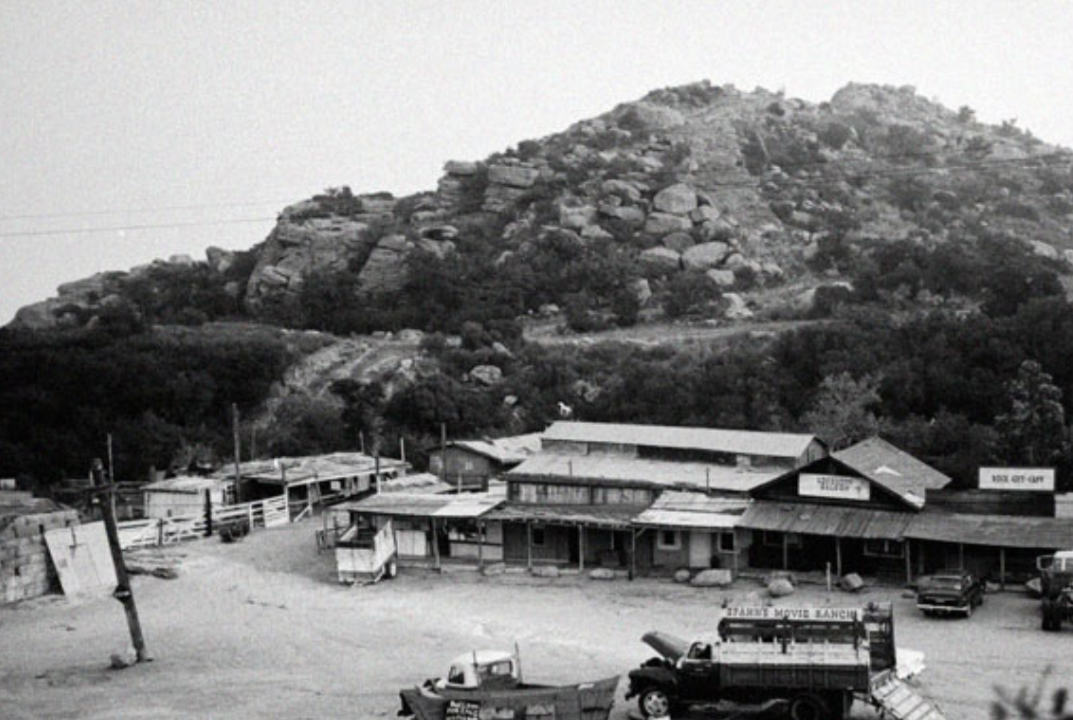
Spahn Ranch in the day
You know the story. By the late 1960s, little filming was actually done on the desolate property in the Simi Hills and Santa Susana Mountains above Chatsworth. Its owner, 80-year-old George Spahn, blind and ailing, now used the ranch for horse rentals.
It was in 1968 that Charles Manson and his followers, “The Family,” came to live at the ranch. Spahn allowed them to stay rent free as long as they help out with chores. This abandoned, isolated ranch, 20 miles from Los Angeles, became the primary residence of Manson and the Family during the time they committed the Tate-LaBianca murders until Manson’s arrest in 1969 during a raid on the property.
The dilapidated buildings of Spahn Ranch burned to the ground in 1970. Mother nature reclaimed the property. It eventually became part of Santa Susana Pass State Historic Park.
On previous trips to LA, when I was traveling alone, I had been reluctant to explore the area. It was not on any tourist map, and I frankly was not excited about stepping on rattlesnakes or getting lost in the wilderness.
In October 2014, Charlie came with me. I was in LA for the second time. The first time was in the spring when I flew out to film an episode of The Ghost Inside My Child.

Charlie and Michael high above Hollywood

Garage where Thelma Todd was found dead
Now, I’ve coaxed Charlie into experiencing some rather wild adventures over our 23 years together, but I don’t think he took seriously my idea of visiting Spahn Ranch on this trip. When we left Hollywood for the coast that morning, just days before Halloween, I had the ranch on my radar for the afternoon.
On our way to Malibu, we stopped in Pacific Palisades and located the garage where Thelma Todd was found dead way back in 1935.
Later that morning, we hiked in Malibu Canyon and rested at the site where they filmed the exteriors for M*A*S*H. After lunch at Duke’s on the coast in Malibu, we turned inland on Topanga Canyon Blvd. for the Valley.
As we neared Chatsworth, the terrain turned mountainous and rocky. Right before we reached Ronald Reagan Parkway, we turned left onto Santa Susana Pass Road and headed west. When we got to Iverson Road, I knew we were there. I looked to the left. Nothing to indicate it was Spahn Ranch. We turned right onto Iverson. Just ahead, we pulled into the parking lot at Church at Rock Peak. Leaving the car, we set out on foot, back down Iverson toward Santa Susana. Just passed the guardrail, we skidded down a bank and found ourselves in brush and brambles.

Spahn Ranch, then and now
As the shadows grew longer in the waning light, I led Charlie down a trail toward the dry creek bed. It had to be here. But where? At one point, the bed was at the bottom of a gully. I had no choice but to go down and explore. Charlie said he’d wait on me. If I found what I was looking for, holler for him.
Clinging onto a branch, I lowered myself down toward the creek bed. When I let go, the leaves and loose rocks sent my feet out from under me (maybe the wine from Dukes had something to do with my unsteadiness).
I tumbled to the bottom, scrapping my shine and breaking the arm of a pair of Revos on the way down.

Scrapes and bruises, but no broken bones
So overgrown with vines and limbs was the area, there was no way to travel along the creek. I carefully pulled myself out of the ravine and met Charlie back on the trail.
Daylight was fading, but not my determination. We walked back toward the road and took another trail that led down into the creek bed. Then it came into view, the cave where the Manson family took their now infamous photo.

The Cave, then and now
It felt creepy being there, that’s about the best way I can describe it. Although decades had passed since the horrible crimes, a sense of evil still hung in the air like a fog. It was time to go.
On the way back to the hotel, we stopped at Iliad Books in North Hollywood — one of my favorite haunts, then had dinner in Studio City at Vitello’s Italian Restaurant. After we turned over the car to the valet, I motioned for Charlie to follow me around the corner from the entrance to the restaurant.
“You know what happened here, don’t you? As I figure it, it happened right about there.”
“No, what happened here,” he asked reluctantly.
“This is the place where Robert Blake’s wife, Bonnie Lee Bakely, was shot to death while she waited for Blake, who had supposedly returned to the restaurant to retrieve a gun he had left behind. Interesting, huh?”
Charlie had had enough. “Come on, I’m hungry.”
My own directions to Spahn Ranch
In the event that you have an afternoon to spare and want to make your own visit to the site of Spahn Movie Ranch, follow my directions.
- Type 22601 Santa Susana Pass Road into your GPS. That will get you close to the ranch.
- Be careful if you park alongside the road. Better yet, park discretely in the church parking lot (Church at Rock Peak).
- Back on Santa Susana Pass Road, walk to the end of the white guardrail.
- Leave the road and follow the trail into the brush. You’re there! Now, explore. Be careful. Watch for rattlesnakes.

Spahn Ranch, a bird’s eye view
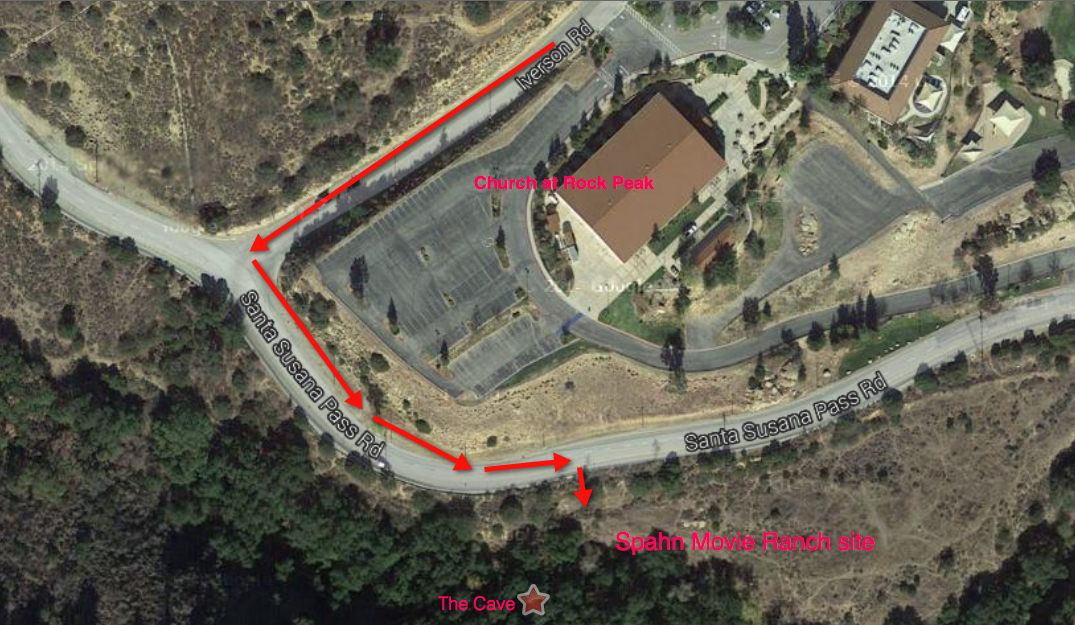
Your map to Spahn Ranch
Jean Sothern: Her Strange Case of Mistaken Identity
By Michael G. Ankerich
Jean Sothern was beyond pissed; she was fit to be tied. In the summer of 1921, the actress, no longer in films, was entertaining her fans in vaudeville houses around the country. Everywhere she went, they were the same questions. What is your connection to Beverly Chew, the Army captain, and his wife, the couple being investigated for forgery? Are you, as the headlines imply, married to Mr. Chew?
They were fair questions to ask. Beverly Chew and his wife were caught in the middle of an investigation that made national headlines for weeks. The worst part, Chew’s wife was identifying herself as film and stage actress Jean Sothern.
Here’s a sampling of the headlines:
Chew’s Wife an Actress
Jean Sothern is Identified as Wife of Chew
Mistaken Identity Figures in Chew Case
The 28-year-old actress who had worked hard to built a reputation and name for herself wanted to know what in the hell was going on.
“I am awfully mad,” she told the press at the time. “All my friends have been telephoning me and asking me if I am Captain Chew’s wife. My booking office called me up. Why, everybody knows that I have never been married. I never have been engaged and I never expect to be. I never heard of Captain Chew in my life. No person who ever saw me mistook me for another woman.”

Jean Sothern
During Chew’s court marshal on Governor’s Island in New York, Jean was eager to set the record straight. She showed scrapbooks of newspaper clippings and photographs from her films.
“I am the Jean Sothern who is the motion picture star. I am indignant that another woman should use my name for any purpose. This thing has gone far enough,” she told reporters.
Director Herbert Brenon testified that Jean had entered films when he hired her for a major role in The Two Orphans with Theda Bara and that she was not the wife of the accused.
When the waters cleared, Marjorie “Daisy” Brennan, whose father invented the bicycle carousel, was identified as the real Mrs. Beverly Chew. Taking the name Jean Sothern, Daisy apparently started in show business a decade before on the stage before making a few films in 1919 for Colorgraph Films in Arizona.
In July 1921, Chew was found guilty and sentenced to seven years — he
served about a year and a half. Mrs. Chew was acquitted. In January
1924, she succumbed to the cancer she had fought for over three years. Variety reported her death under the name Jean Sothern. Further confusion!
The mistaken identity plagued the real Jean Sothern for the rest of her life. Many assumed the actress who had starred in about a dozen films for Fox, Imp, and Pathe had died in 1924. At least two film references, Who Was Who on Screen (Truitt) and Who’s Who in Hollywood (Ragan), give 1924 as the death year of the actress. As of December 2014, the web site International Movie Database states that Jean Sothern, known for A Mute Appeal (1917), The Mysteries of Myra (1916) and The Cloud (1917) died in 1924 and was the wife of Beverly Chew.
Pe rhaps Jean Sothern had the last laugh. She lived another 40 years.
Sadly, few have taken the time to explore and get to know the real Jean Sothern, dainty star of the silent screen. The time has come. Here’s her story.
Jean Sothern was born Grace R. Bomberger on December 5, 1893, in Lancaster, Pennsylvania. She was the only child born to William and Olivia (Eshleman) Bomberger.
By the time she was 15 and a sophomore in Coatesville High School, Grace was entertaining delighted audiences with her singing in neighboring towns. In 1909, the Philadelphia Inquirer lauded praise on the young entertainer, noting her “voice of great range and purity, besides which she plays both the piano and violin with considerable skill, and has exceptional ability as an elocutionist.”

Edwin Liebman, orchestra leader for Loew’s America in New York City,
and his family took Grace under their wing. The Liebmans “adopted”
Grace. In interviews about her life, she often referred to Edwin Liebman
as her father.
For a short time, she used Esther Robinson as her professional name — Robinson was the maiden name of her father’s mother. Theatrical manager Arthur Blondell gave her the name Gene Southern, which she changed to Jean Sothern.
By 1914, she had developed a stage act for Loew’s circuit. A little over five feet tall, Grace was billed as the Little Dynamo of Personality.
A stroke of fortune came to Jean when director Herbert Brenon hired her to appear as the blind orphan with Theda Bara in The Two Orphans (1915) — later remade as Orphans of the Storm.

Jean (center) played the blind orphan in The Two Orphans
On the merits of that film, Jean was selected to play the title role in The Mysteries of Myra, a 17-chapter serial that tells the story of Myra Maynard, the daughter of an Occult leader, who is repeatedly hunted by her dead father’s devil-worshipping Order. (See the lost trailer for Mysteries of Myra.)

Jean in The Mysteries of Myra
 The
authors of the series, Hereward Carrington and Charles Goddard, were
said to have conducted a number of psychological tests on actresses
testing for the part. They selected Jean because of her “extraordinary
mental powers,” feeling that the leading lady “must be capable of
portraying the emotions of one subject to the compelling influences of a
superior will. She must have grace, poise and a personality which will
actually reach out from the screen, take possession of the people and
make them instinctively, irresistibly respond to each impulse and thrill
with every emotion which the star experiences.”
The
authors of the series, Hereward Carrington and Charles Goddard, were
said to have conducted a number of psychological tests on actresses
testing for the part. They selected Jean because of her “extraordinary
mental powers,” feeling that the leading lady “must be capable of
portraying the emotions of one subject to the compelling influences of a
superior will. She must have grace, poise and a personality which will
actually reach out from the screen, take possession of the people and
make them instinctively, irresistibly respond to each impulse and thrill
with every emotion which the star experiences.”
Although the series was widely popular and made little Jean a star, she never wanted to make another serial. “I don’t like serials,” she said later. “There must be some sort of climax in each episode — a jump off the mountains or a fall into the river, and honest I had to be pushed off when I fell in the East River in one of the episodes.”
The actress stuck to feature films. In 1917, Jean contracted with Van Dyke Film Production Company. In rapid succession, she starred in Her Good Name, The Cloud, A Mother’s Ordeal (in the roles of the mother and daughter), A Mute Appeal, and Miss Deception, all 1917 releases. She made her final film in 1918, Peg o’ the Sea.

Jean as she appeared in Peg ‘o the Sea
The actress devoted herself to the war effort. She sold war bonds from the Liberty Bond booth at Penn station in New York.
By the late 1910s, Jean Sothern had acquired a legion of fans, who were saddened to read in the magazines that she had married a U.S. Army officer and was living at Fort Leavenworth, Kansas. Jean was quick to deny the rumor. Little did she know, this was the first incidence of mistaken identity that would explode in the papers four years later.

Jean in The Cloud
With no film work in sight, Jean put together a vaudeville act and hit the road to meet her public. She was asked about her personal life and the decision she made to bob her flowing blonde locks.
“That was really ugly of me and you tell the other girls not to do it,” she told a reporter in 1919. “I had my curls in The Two Orphans and all the papers wrote afterwards of them being like Mary Pickford’s, as though nobody could have any curls but her. So one day I slipped away and cut mine off. My friends wouldn’t speak to me for two days. When I appeared at Birmingham, Alabama, seven girls bobbed their hair like mine, and then I was sorry. Mine have grown out now and I’m glad. I’ll never be so foolish again.”
An exhausted and travel weary Jean Sothern arrived in Tulsa, Oklahoma, in April 1919, around 1 in the morning. The next day, a reporter questioned her about films and stage work. Did she have a preference?
Jean didn’t hesitate. She preferred films because she could live in
her family home in New York, not in cold and drafty hotel rooms in
unfamiliar cities. “I love to clean house, to sweep and to get in the
dirt and scrub — but I can’t cook,” she revealed. “I hate to travel. I
love a home, and do tell the girls for me, especially those who think it
would be nice to be a movie actress, that really and truly the nicest
thing girls can do, I believe, is to grow up and get married and have
babies. I just know that movie life is hard and, in vaudeville, the most
unpleasant part is the traveling.”
The most bizarre part of her travels came in 1921, less than a month before her name was linked with the other Jean Sothern and Captain Beverly Chew. When she arrived in New Orleans in May, Jean visited Matilda Levee in prison. Mrs. Levee was behind bars for murdering her husband, Fred Levee, the prominent New Orleans and Los Angeles attorney. Jean interviewed the woman and wrote a lengthy story about the case for the local newspaper.
With little problem, Jean weathered the debacle over being mistaken for the wife of Beverly Chew. By the time the obituary of Chew’s wife appeared in Variety, Jean was entertaining audiences with a new vaudeville act: Girls Will be Boys. The show promised a “bit of femininity with a masculine twist.”
Jean was a hit. One Oregon newspaper wrote in January 1924, “She is a true comedienne and even her eyes talk. She dons boy’s apparel and is a real boy, once as a swaggering, boastful sailor, once as a scared-to-death hayseed, and again as a dashing, man-about-town. The audience loved Jean’s honesty and gifts and her personality cut a deep dent.”

Jean in the mid-1930s
In 1930, Jean embarked on a new adventure: radio. Without revealing her true identity and vast experience in entertainment, she requested an audition with the Columbia Broadcasting network. She provided three or four versions of her act and spoke in some of the dialects she had perfected. The organization wisely grabbed her up.
Jean Sothern found her home in radio. She played the role of Edie Gray in the popular NBC serial Pepper Young’s Family.
She became an animal dialogue expert and provided Dutch, Irish, French, Southern dialects when needed. She was once referred to as the “most versatile actress in radio.” Although she is credited with playing the role of a waitress in Down the Wyoming Trail (1939), after watching the film, I question whether the actress is the Jean Sothern of the silent screen.
Jean eventually returned to Lancaster, Pennsylvania, where she died of throat cancer on April 14, 1964. She is buried at Octorana Church Cemetery in Parksburg, Pennsylvania.


Jean Sothern’s final resting place
Interview: William J. Mann tackles murder, morphine, and madness in Tinseltown
Interview by Michael G. Ankerich
William J. Mann serves up a delicious plate of M’s in his new book, Tinseltown.
Mary, Mabel, and Margaret.
Murder, Mystery, and Madness.
Mary and Momma.
I devoured every morsel of the buffet.
The unsolved murder of director William Desmond Taylor in 1922 is one of the reasons I stepped back into the silent film era — and stayed! It’s the classic whodunit.

Who did it? Was it Mary Miles Minter? Mabel Normand? Charlotte Shelby, Mary’s mother? Starlet Margaret Gibson? His valet? Drug dealers? Gangsters?
Bill Mann, one of my favorite authors of old Hollywood, thinks he has solved the mystery. You’re going to have fun with this one, friends! Tinseltown: Murder, Morphine, and Madness at the Dawn of Hollywood reads like a novel, yet the dialogue is not drawn from the author’s imagination. The words between the quotation marks came from the mouths of those who spoke them.

Bill reconstructs the riveting case using primary sources — including witness testimonies from police records, coroner’s inquest files, newly uncovered FBI records, and court records and transcripts.
Running alongside the murder mystery are complex and interesting portraits of legends like Adolph Zukor and Will Hays, the first czar of Hollywood.
So who killed William Desmond Taylor? Listen in on my conversation with Bill and find out.

My collection of William J. Mann books
Michael: I first started reading your books in the 1990s. I must have read The Men From the Boys when I was coming out or shortly after. Then I read your novel around the “afterlife” of Florence Lawrence. Two of my favorites are your William Haines biography and Behind the Screen, about gays and lesbians in Hollywood. I’m intrigued by your body of work and the range you’ve covered. Most writers find an era or genre, but you’re all over the place. What do you look for you when you’re selecting a subject to write about?
Bill: It’s always about the story. Is it a good, compelling story? Can I say something new? I think being a novelist helped me discern the story within a life or within a topic. For example, when my editor wanted me to write about Streisand, I was reluctant. Not really my thing. But when he suggested we call it “Becoming Barbra” that hooked me — because I could see the story, of an unknown, unlikely kid becoming a huge star in just five years time. So it’s always Story, Story, Story for me.

Hello, Gorgeous
Michael: So let’s talk about Tinseltown: Murder, Morphine, and Madness at the Dawn of Hollywood. After over 92 years of wondering, do you really think you’ve solved the mystery of who murdered William Desmond Taylor?
Bill: Would my evidence stand up in a court of law? I don’t know. After nearly a century, so much of the evidence I present is necessarily circumstantial, since so much physical evidence is gone. I was fortunate to find FBI records —not on the Taylor case per se, but on some of the figures around him, which helped me to draw some key conclusions. Also, the fact that so many newspapers are now digitized I was able to find proverbial needles in the haystack that allowed me to make connections. There will be people who disagree with my conclusion, and that’s okay. I have always said that I submit Tinseltown into the lore of “Taylorology” and will let people draw their own conclusions. No one really wants cold cases solved. That strips away so much of the fun for armchair detectives. There was a lot of pushback to the recent claims that the identity of Jack the Ripper was discovered. But I do think that my solution is the only one that doesn’t contradict other available evidence and the only one based on surviving documental evidence, even if it’s circumstantial. That’s really important—to show where and how you drew your conclusions. I have got something like 800 footnotes and will be posting a lot of the primary documents I used on Taylorology, courtesy of the really brilliant Bruce Long, who more than anyone has kept the taylor case alive.

Michael: In the history of Hollywood, has there ever been anything like the murder of a leading director, a mystery that has gone unsolved for so long? The one that comes to mind is the mystery around the death of Thelma Todd.
Bill: I am very intrigued by the Todd case, but even that wasn’t as huge as the Taylor case. The reasons are a few: one, Taylor was really very prominent, a key figure high in the industry with the support of bigwigs like Zukor and Lasky. Two, the scandal ensnared so many other leading figures in the industry. Three, and most important, it occurred right at the moment when the stakes were so high for the film industry, when not only the threats of bad publicity and censorship hung over the movies but also federal regulation. That’s why it was so important to contain the fallout from all the scandals of the 1920-1923 period, and Taylor’s death was, in my opinion, chief among them.
Michael: Why are we still interested in a story that happened so long ago?
Bill: I think we’ll never tire of whodunits. And the characters in this story are just so complex and fascinating. Mabel Normand—I fell in love with her. So strong, so resilient, so full of integrity, so ahead of her time. Mary Miles Minter, so young, so deluded, so abused, so tragic. Margaret Gibson, so determined, so ambitious, so cunning. And Adolph Zukor— he created the movies as we know them, and he always so desperate not to lose everything and go back to being penniless and irrelevant. Will Hays, too, really fascinated me. Hardly the prude and puritan he’s long been considered, he was actually quite pragmatic, progressive, and nonjudgmental.

Mabel Normand

Mary Miles Minter signed this photo to “My Mammy”

Margaret Gibson / Patricia Palmer
Michael: How hard was it to sell this type of idea to your agent / publisher?
Bill: I thought it might be terribly difficult. After chronicling three huge names — Hepburn, Taylor, Streisand — this was a bit of a departure and I know how publishing works. They always want an easy sell. So I worked on the idea for several years before I sold it. I’d stay up at night when I was tired of writing about divas all day. In that way, I had the story all fleshed out, and to my great surprise and pleasure, we had several editors bidding when we finally offered it. The editor I ended up with, Cal Morgan, at HarperCollins, is a real advocate of early film studies and popular culture histories. He’s been fantastic.

Mary Miles Minter and her mother, Charlotte Shelby
Michael: When I interviewed those still left from the silent film era, most believed that Taylor’s murderer was Charlotte Shelby, the mother of actress Mary Miles Minter. She was an easy scapegoat, not the most loved in Tinseltown. It doesn’t sound like, after reading Tinseltown, that Mary ever referred to her mother as Mommie Dearest. In the long line of stage mothers, was she really that bad? Does she get a bad rap from film historians?
Bill: I think she was pretty monstrous to Mary. Some of the things I write about in Tinseltown—like burning Mary’s doll when she was a child—are just shattering.

Mamma and Mary
But I think we also have to respect her professionally. Pretty much all on her own, Shelby took on the system and won—a rare example of a woman succeeding in an industry dominated by men, and winning on her own terms at that. A strong, forceful woman is always going to attract more enemies than a strong, forceful man.
Michael: The murder of Taylor impacted so many lives. Besides the obvious, Taylor himself, who, in your opinion, ended up the biggest loser in the whole Taylor murder saga? How and why?
Bill: Well, so many suffered, but I would say it was Mary who really ended most tragically. Obsessive, a bit of a manic-depressive, terribly self-absorbed and delusional— but after her horrible childhood and the abuse she endured in the press, you can understand how she ended up that way. Her life after Hollywood was so sad. Taylor’s death followed her right until the end of her life.

Michael: Another intriguing part of Tinseltown revolves around censorship and the influence of the religious right on the film industry during those days. It seems that, every so often, this influential group latches onto a cause and creates headlines. I think of abortion and gay rights in our day, but in the early 1920s, it was the content of movies, movie stars, and bathtub gin, wasn’t it?
Bill: In many ways, Hollywood of 1922 reminded me so much of Hollywood in 2014. Stars becoming better known for off-screen exploits than their on-screen work; religious conservatives were decrying “Hollywood values” and the effect they were having on the nation; companies were buying each other up; and the government was trying to get a cut from all that cash. I think the reformers who were trying to censor movie content and censure star behavior recognized the secular, modern world that Hollywood was creating, and they were trying to stop it. Of course, the influence of the movies couldn’t be stopped. So much of the public in those pre-mass-market days hadn’t seen beyond their local communities. But Hollywood opened a window for them and after seeing the big wide world, they weren’t ever going back to more provincial views. I think an analogy can be made to movements today that are trying similarly to stuff the genie back into the bottle. Just ain’t gonna happen.
Michael: I want to touch on several of your other books. Was How to be a Movie Star: Elizabeth Taylor in Hollywood the first biography that you wrote about a living person? How does that compare to writing about someone, say William Haines, who had already lived their life?
Bill: With Elizabeth, her people—her friends and family—were very cordial about me writing the book; some spoke to me; some did not. But Elizabeth was too ill at that point to cooperate. It does make it more sensitive writing about someone who’s still alive. Part of the reason I loved researching and writing Tinseltown was because I did not have to beg or cajole anyone to talk to me. They were all dead.

Michael: I thoroughly enjoyed The Biograph Girl: A Novel of Hollywood Then and Now, which has Florence Lawrence, filmdom’s first movie star, who supposedly died in 1938, still alive at 106. Where did your inspiration for that book come from?
Bill: It was just a wild idea I had one day. Florence Lawrence had always fascinated me. She was so huge, so adored—and then so utterly forgotten. She had started this whole crazy business of stars and celebrity — well, with some help from Carl Laemmle who rigged up the first movie-star publicity stunts for her. I just felt she ought to get one more shot at fame.

Michael: You dedicated The Biograph Girl to your mother and father who bought you your first typewriter when you were only nine. Were you writing then and how influential were they in your development as a writer?
Bill: I absolutely was writing then, back in those prehistoric days before computers. I thought a typewritten set of pages would look more like a “real book” than all the ones I’d been writing out in pen. My Mom and Dad absolutely loved that I became a writer. My Dad passed away last year but he would read every volume and ask lots of questions afterward. I just gave my Mom Tinseltown. At 88, she was insistent that all this was “before her time.”
Michael: You always credit your husband, Tim Huber, in your work. How interested is he in old Hollywood? Does he share your interest?
Bill: He loves it through me. After 26 years together, he’s seen enough classic Hollywood films with me to know quite a bit. But every once in a while, while we’re flicking through Netflix, he’ll say, “Can’t we watch something from this century this time?”
Michael: How and when did you first become interested in Hollywood of the silent film era? Were there writers whose books inspired you back then? Who and which ones?
Bill: When I was a kid, those of us who loved silent film and early sound film really struggled to find anything to increase our knowledge about these wonderful movies, which were almost completely inaccessible. So I devoured the books of Kevin Brownlow and Anthony Slide. I was also really fascinated with the very early films, and had a correspondence with Charles Musser, whose research into the nickelodeon era was so groundbreaking. I remember him being surprised that this teenager was so interested in Edwin S. Porter and Georges Melies!

Keep track of William J. Mann through his website, williamjmann.com
Michael: What’s next for you? Are there any projects in the works that you can tell us about?
Bill: My next book is my first non-Hollywood project. It’s called Alice & Eleanor: The Wars of the Roosevelts, about the rivalry between those two first cousins, one Republican, one Democrat, one beautiful, one plain, one gregarious, one shy—and both brilliant. But what I’m discovering is that Washington and Hollywood aren’t really all that different. They’re both about the creation and merchandizing of public images. That book will be out in 2016, hopefully in time for the presidential campaign.
* * *
Bill and I never got around to discussing who committed the murder. That, my friends, is up to you to discover for yourselves!
Can we tawk? Missing Joan
No one cracked me up like Joan Rivers, unless it was Carol Burnett and Vicki Lawrence as Eunice and Mama.
Back in the mid-1980s, when I could still stay up until 11:30 without taking an afternoon nap, I would catch Joan on The Tonight Show. Never cared much for Carson, but Joan made me lose my breath. I loved the jokes about slutty women — “Her thighs have landing lights”– and her sex life, which she said had dwindled to leaning against the washing machine on spin cycle.
I met Joan briefly several years ago when I was in San Francisco researching Dangerous Curves Atop Hollywood Heels. We passed each other on Castro Street. I realized the tiny blonde woman in big movie star shades was Joan Rivers. I turned around, followed her to the corner, and chatted with her while we waited for the light to change.
Many years before our brief encounter, I sent Joan an index card and asked her to autograph it and provide me a print of her lips, not knowing whether she could keep them still long enough to press them to the paper. She did!

I’m really going to miss this comic legend with the cutting tongue. Give yourself a laugh this morning. Check out this monologue from 1984. Wherever Joan is today, I hope she’s lying on her back and seeing more ceilings than Michelangelo.

Maurine Powers, “daughter” of Zorro, update
Several updates to my recent post, Maurine Powers: How the actress became Zorro’s daughter, that I had to share with you.
On my recent to trip to Los Angeles, I found a nice autographed portrait of Maurine. “To Rutgers, with best wishes, from Maurine.”

Maurine Powers autographed portrait
Also, after reading my post, photographer Jeremiah Ellsworth sent several photographs of a Maurine (Powers) McCulley painting that he purchased in Arizona. Have a look at his painting and check out Jeremiah’s website.

Painting by Maurine Powers

Portrait signed by Maurine McCulley
Thanks, Jeremiah! It’s super knowing that Maurine’s work is still being enjoyed and appreciated!
Ready for her closeup: Amy Pierce confronts her troubling past life as a silent film actress
By Michael G. Ankerich
In my last blog, Lucille Ricksen, Reincarnation, and my Television Debut, I shared a bit more about my May adventure in Shadowland and introduced you to Amy Pierce and her mother, Theresa. Amy and Theresa are featured in an upcoming episode of Ghost Inside My Child, a Lifetime Movie Network series that airs August 23. The show explores Amy’s revelation that the spirit of silent film actress Lucille Ricksen lives inside her.
I spent some time with Amy and Theresa when we were in Los Angeles filming scenes for the show. My time with them and the Ghost Inside My Child crew turned out to be the highlight of my trip.
I’ve spent a lot of time in Hollywood researching days long past, the parade gone by. I dig beneath the surface to see old Hollywood among the current chaotic world that the modern day movie capital has become. I love the bizarre and out of the ordinary, but I have to admit that it was a bit surreal to talk with a 17-year-old teen from Minnesota who insists that she once lived as Lucille Ricksen.
What would it be like to discover you had once lived another life, a life that ended tragically and mysteriously almost 90 years ago?
I asked Amy, who has the beauty and glamour of old Hollywood, to share her story.

Amy

Olive and Jack


Theresa and Amy

The scene where Amy shows her mother a photo of Lucille Ricksen and tells her she once lived as the silent film actress

Amy’s niece portrayed Amy as a five-year-old

Amy comes to Hollywood
Michael: Was it generally known in your neighborhood that the crew was coming?
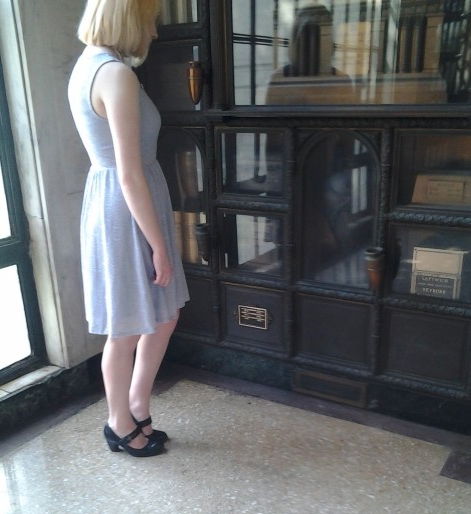
Amy at Lucille’s final resting place

The crew film Amy and Theresa in front of the house where Lucille died

Amy and Theresa get a closer look at the house where Lucille died

Michael and Amy after the filming of our scene

Lucille Ricksen

Amy as Marilyn


Amy reclines with Jack Pickford’s star on Hollywood Boulevard
Don’t miss this thought provoking episode of Ghost Inside My Child on Lifetime Television Network, Saturday, August 23.
Lucille Ricksen, reincarnation, and my television debut
By Michael G. Ankerich
Destiny turns a dime, or so says the old Pam Tillis tune.
Three months ago, in early May, I thought my weeks ahead were inked into my calendar. I was busy working on my new book, Hairpins and Dead Ends , and packing the house for a move across town.
A phone call changed all that! Welcome to Mi Vida Loca . . . and my television debut.
On the line was Sandra Alvarez, a producer for Ghost Inside My Child, a Lifetime Movie Network series. She talked about me coming to Los Angeles later in May to film a scene for an upcoming episode that would air in the fall.
I listened.
The company was developing a story around a 17-year-old teenager in Minnesota who, since the age of 12, believed that the spirit of silent film actress Lucille Ricksen lived within her. The crew had gone on location to Minnesota to film Amy and her mother and father in their home. The crew was then returning to Hollywood where Amy and Theresa, Amy’s mother, would visit some spots that might trigger memories.
Sandra was interested in filming a scene in Los Angeles where I meet Amy and Theresa and tell them about my research into the life and tragic death of Lucille Ricksen.
I devoted a chapter to Lucille in my book Dangerous Curves atop Hollywood Heels. I have also written about her in Lucille Ricksen: Sacrificed to Hollywood, this blog. The story of the teenage actress who became a leading woman overnight has stayed with me since I dove into the details of her short life and tragic death.
Lucille’s mother, Ingeborg, brought Lucille and brother Marshall to Hollywood to seek fame and fortune on the silver sheets around 1920. Lucille was 10 years old. Success came to the youngster. She played a happy-go-lucky juvenile in the serial The Adventures of Edgar Pomeroy for Goldwyn.

Lucille around 1920
In three short years, Lucille became trapped and exploited in the industry’s publicity machine. Overnight, she went from being a 13-year-old spunky kid doing what she loved to a 16-year-old leading lady, portraying all the struggles of adulthood. Those dramas spilled over into her private life.
In one year, Lucille completed 10 feature films. Exhausted from her work, the actress disappeared behind closed doors in her Hollywood home. Ingeborg kept vigil. One morning, the emotionally drained mother collapsed and died across Lucille’s sick bed. Less than a month later, the broken-hearted actress joined her mother in death.

After all these years, the lingering question has not been answered. How did the young actress really die? Tuberculosis? Exhaustion? Botched abortion?
The invitation to meet Amy and to appear on the show had all the elements that intrigued me: a walk into the supernatural; a look back at early Hollywood; and contact with someone intensely interested in old Hollywood. But reincarnation? I had given little thought to the subject over the years. I, too, feel pulled to Hollywood, especially the Hollywood of the 1920s. For some unexplainable reason, it feels like home to me when I am out there in the middle of all of it. Does a spirit who lived there in that time now reside in me? If I were to even ask the question, my Baptist roots would wrap around me and yank me down the backslidden trail. Now, as an Episcopalian, I have room for exploration and wonder.
In the end, I decided to venture out to Hollywood and meet Amy and her mother. (Click here to read more about my most recent Hollywood adventure). I even filmed a scene for the show. Sandra, the producer, asked where I thought we could shoot our scene. I suggested the old Biltmore Hotel in downtown Los Angeles. Built in 1923, the grand hotel is steeped in Hollywood history. It provided the perfect setting for our meeting.

The grandeur of the Biltmore Hotel, Los Angeles
Sandra insisted that I not meet the Pierces until we filmed our scene. That way, our conversation would be fresh and spontaneous. As the cameras rolled, Amy and Theresa walked in and we introduced ourselves. CUT! The action then moved to a table where, for the next 30 minutes or so (it seemed like days), I told Amy about my research. I asked her questions; she asked me questions. It was everything Lucille!

Michael, Theresa, and Amy
When our work was done at the Biltmore, the crew took us to a deli for lunch. In the afternoon, we drove into Hollywood, to the home where Lucille died in 1925. The crew filmed Amy and her mother walking down the street, across the yard, and onto the front porch.
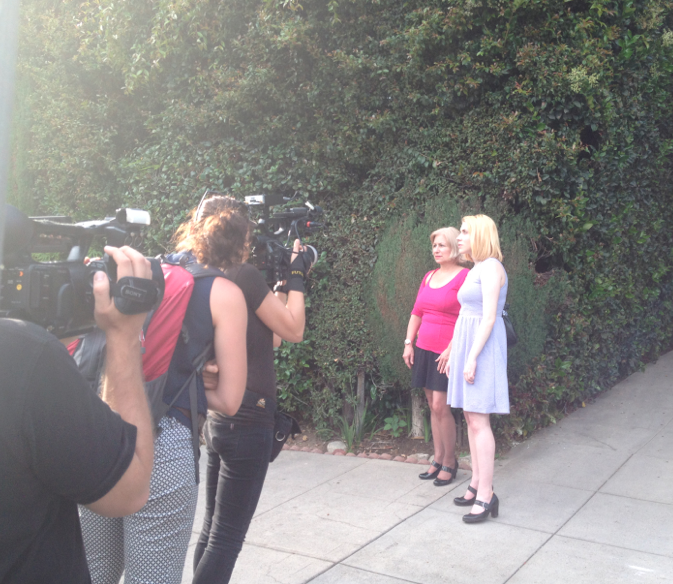
Amy and her mother get their first look at the house where Lucille died in 1925
Amy was overwhelmed. She said she had definitely been in the house. It was in the front left room where she insisted she died almost 90 years before.
Meeting Amy and her mother was the highlight of my 2014 adventure to Hollywood. Amy has the glamour and look of old Hollywood. Her mother was fun to be around, down to earth, and engaging.
Does the spirit of Lucille Ricksen, who died so tragically from mistreatment in a profession she loved, live on in a 17-year-old teenager living quietly in Minnesota. That is a question, my friends, that I can’t answer. Decide for yourself.
Mark your calendars for August 23, only weeks away. Tune in to see this haunting episode of Ghost Inside My Child on Lifetime Movie Network, hear Amy tell her story, see my television debut (that is, if I don’t end up a face on the cutting room floor). Visit the show’s website and read my revealing interview with Amy in an upcoming blog entry.

Hoarders (Not Quite) Anonymous!
By Michael G. Ankerich
Okay, I’m coming clean. I am finally able to make a confession.
Several months ago, while packing the house to move across town, I began asking myself, “Do I have a problem with letting things go? Is it possible that I could be a hoarder?”
I was ready to admit that I had some sort of OCD when it came to books. I packed 30 boxes of film biographies to go to my new library. That did not include film reference, signed first editions, classic literature, and modern day smut. I spent several agonizing days discarding some of my treasured biographies.
Books, books, and more books
Who really needs 14 biographies of Elizabeth Taylor? I got rid of three or four. Who needs one on Anna Nicole Smith? Out it went. I made some concessions, but I wouldn’t budge on my 15 Bette Davis bios. They all go with me! End of discussion.

Not one Bette Davis biography was sacrificed in my recent move.
Moving forward, relocating to a new home, prompted me to look back over my life and the artifacts that I kept along the way. I found my ID badge from the 1970s when I was a bag boy at a grocery store. Keep it? Pay stubs from 1985 when I was a newspaper reporter fell from a folder. Those slips of paper went in the shredder. There are the neck ties that I wore back in the 1980s when I tried to be a fashion plate. They called me Mr. GQ in college. They were easy to let go. What to do with the stubs from train tickets we used to cross Italy for the first time in 1995? What about the anniversary, birthday, and Valentine cards Charlie gave me over the past 23 years?
Underneath a big pile of clothes way back in the closet, I found my Greta Garbo tee-shirt from the early 1990s. Oh that memory! I was wearing that shirt the day Charlie and I were in line at an Atlanta art supply store. The elderly cashier smiled when she saw it. “They used to tell me I looked like Garbo.” I didn’t see it.
What to do with the floppy disks which held files from my first book, Broken Silence: Conversations with 23 Silent Film Stars? They are the ones I grabbed when my apartment caught fire early one Saturday morning in 1991. Thirteen years later, what do you do with floppy computer disks? Put them in the Smithsonian? Use them for coasters?
I discovered a box of my grandmother’s belongings. I hadn’t looked at them in the 10 years since her death. I found get well cards from the 1970s and a pair of false teeth. What do I do with a pair of Mama Sue’s false teeth?
Through this ordeal, I kept thinking of Maxine Elliott Hicks, an actress I interviewed for Broken Silence, that day in Burbank when we had breakfast and went through her trucks full of stills and contracts and letters. She loaned me what I needed for the book, but needed them returned. “They’re all I have to prove who I was.” That’s kind of the way I felt throwing away my past.
In the middle of all this packing and sorting, I had to jet out to Los Angeles to film an episode of a television show (more details soon) and do a bit of research for Hairpins and Dead Ends, my new book.
I spent some time reflecting on all my stuff and whether I should classify myself as a hoarder.

In Venice Beach, taking a rest from my bike ride
Cycling along the coast from Santa Monica to Hermosa Beach left me with nothing but a damned sunburn and irritation at two religious fanatics on the Santa Monica Peer shouting through megaphones that most of us passing by were going to hell.
“You liars are going to hell.” The other translated in Spanish.
“You gluttons are going to hell.”
“You adulterers are going to hell.”
“You drunkards are going to hell.
“You lesbians are going to hell.”
“You homosexuals are going to hell.”
“You fornicators are going to hell.”
“You covetnous are going to hell.” Oh, hell, I wondered, does that include hoarders?
As I passed by, I couldn’t resist. “Well,” I said to one of them, “it looks like you’ve just about covered all of us.”

Hollywood Sign from Griffith Park
My life certainly felt uncluttered on my hikes in Griffith Park high above Hollywood or on my trek through Malibu Canyon.

Hiking in Malibu Canyon

Visited the site in Malibu Canyon where M*A*S*H was filmed.
I certainly didn’t feel shackled by stuff the day I went to Rosedale Cemetery to look for the graves of Louise Glaum, Marshall Neilan, Hattie McDaniel, and Evelyn Nelson, a victim of suicide in 1923 and a subject I’m researching for Hairpins and Dead Ends.

A selfie at Louise Glaum’s grave. Yes, I know I look like Jed Clampett. I am protecting my face from more sunburn.
I sat sipping wine one afternoon in Duke’s, my favorite restaurant in Malibu. As I recorded the events of day in my journal, I wondered who would ever read these memories.

Journaling at Duke’s along the coast in Malibu
I had boxes of journals I had written during our travels over the years. Maybe I should go through and send them to the dump. Then I remembered what the beloved Mae West always said, “Keep a diary, and someday it’ll keep you.” I kept writing.
Back home in early June, I dove into the clutter and made some tough (for me) choices. They say a man’s home is his castle, his kingdom. For me, home was my “hoardom.”
With everything I touched, I had to ask myself five questions. Do I:
Keep it?
Haul it to the street?
Put it in a yard sale?
Give it to Goodwill?
Friends, I must have made a million decisions since I began this grueling self examination. The good news is that we are settled in our new digs.

My new office
The office is in order and I’m back to writing. There are still boxes piled in what will one day be a spare bedroom. I am committed to tackling their contents and making rational decisions about what to keep and what to throw away. Through all of this, I’ve decided I will no longer associate stuff I’ve stored away with me or my past. I don’t want any part of me to live in a closet or the bottom of a drawer. I am more than a box of old pay stubs or birthday cards going back half a century.
A close friend tried to console me. “Michael, you’re just sentimental,” she offered. “There’s nothing wrong with that!
I am sentimental, that’s true, but I also unconsciously collect things that don’t make a whole lot of sense. I confess, I am a hoarder, but a recovering one, committed to tackling my disorder one floppy disk, one dry ink pen, one old and yellowed magazine at a time.
Oh! For the record, I kept Mama Sue’s false choppers!
The world according to Fontaine La Rue and other upcoming Hollywood adventures
By Michael G. Ankerich
If you know me at all, you know that I have a thing for actress Fontaine La Rue. I can’t call her my favorite actress because I’ve never seen one of her films. I like her as a personality and for so many other reasons.

Fontaine La Rue
When I began searching for her about two years ago, I had no idea she would be so hard to track down. I devoted a blog to her early last year, Where are you, Fontaine La Rue?, when my frustration over dead ends almost led me to the attic on a quest for my old Ouija board.
Just about the time I opened the door and was headed into the dark attic to connect with the supernatural, the most amazing thing happened. Fontaine’s family got in touch and told me all about their grandmother, their aunt, their great aunt. It turns out that Fontaine was even more interesting than I realized.

The ever mysterious Fontaine La Rue
I’m dusting off my wings and revving my engines for a flight out to Hollywood this weekend. I will continue the research for my new book, Hairpins and Deadends: The Perilous Journeys of 20 Actresses Through Early Hollywood, and will type away on some chapters that are ready to be written.
My main focus is getting better acquainted with Fontaine. I’m not meeting her face-to-face or chatting with her over tea, of course, but I’m visiting her final resting spot (since 1964) at Calvary Cemetery and those places that were special to her: her mansion on North Van Ness Avenue in Hollywood and St. Vincent de Paul, the church where Fontaine exchanged wows with her first husband, the father of her three children.
I’m devoting a chapter to Fontaine’s life and film career in my new book — how could I not? — so I’m not telling everything I know. I can tell you that everything I thought I knew about her at first was wrong. How did Matilda Fernandez, a young immigrant from Mexico, survive family tragedy in her native country to find her way into the studios of the 1910s as Dora Rogers (later Fontaine La Rue) and vamp her way into the hearts of movie fans over the world. That’s the story I want to tell.
There’s more in store for me in Los Angeles than just Fontaine. I’m doing some hiking and biking. I’m pouring through the Los Angeles Examiner archives, visiting friends, and dining at my favorite Chinese and Italian restaurants. Did I also mention that I am filming a scene for a documentary about a silent film actress I’ve written about in the past? Yes, my first experience before the camera, but I can’t miss the opportunity to talk about an actress whose heartbreaking story still haunts me. I’ll fill you in on the details when I can.
Oh! Here’s another plea. If you are a relative of actresses Vivian Prescott, Lolita Lee, Evelyn Gibson, or Lila Chester, please let me hear from you. I have lots of clues, but I’ve reached a dead end on whatever became of them. I’m also deep into research about Estelle Mardo. I want to know where she went after she disappeared and was never heard from again. Members of her family, equally perplexed, would also like to know.
There’s a lot of mystery about the early days of the film industry and those actresses who made their livings before the camera. It’s frustrating to someone who is researching and writing a hundred years after the fact.
That’s the way it is, my friends, with hairpins and dead ends.
Maurine Powers: How the actress became Zorro’s daughter

Maurine Powers
To understand how actress Maurine Powers became the daughter of Zorro after her fleeting film career came to an end, we must start at the beginning, not with Don Diego de la Vega, but with a young woman in Illinois named Daisy.
She was born Daisy Louise Munsey in the early 1880s in Illinois to John D. and Marietta (Garner) Munsey. While she was talented in many areas and enjoyed several careers during her life, she excelled in marriage. Daisy made marriage a vocation.
In June 1898, the teenager married Frank May, a salesman. Little Maurine came along in March 1899. When the May marriage went on the rocks, Daisy became Mrs. Curtis W. Baker. The Bakers settled in Terre Haute, Indiana.
Curtis was a traveling salesman for Page Fence Company. While Curtis traveled, Daisy had the wandering eye. Her sights settled on Andrew W. Powers, a man active in local politics. At one time, he was the city chairman of the Democratic Party. Curtis learned of the developing relationship and took his anger out on Daisy. He fired off two shots at his wife, hitting her once in the leg. He then turned the gun on himself. With one shot to the head, he was traveling to the Great Beyond. By 1910, Powers was living with Daisy, 10-year-old Maurine, and Daisy’s mother in Terre Haute.

Daisy, who possessed an entrepreneurial spirit, opened a women’s hat shop in Terre Haute. In July 1912, Daisy and Andrew Powers bound themselves in marriage. Maurine became Maurine Powers.

Maurine modeling one of Daisy’s hats in a 1910 newspaper ad.
As little Maurine became a teenager, it was clear she possessed a talent for drawing and painting. At the age of 15, the little artist, a sophomore at Wiley High School, was commissioned to paint a 36 x 24 oil painting for local resident Florence Moir. She committed herself to a serious study of art after she finished school.
After high school, however, Maurine and Daisy traveled to the Great White Way. In New York, Maurine Powers broke into the movies. By 1918, she had appeared in nine films for Metro. It was director William Nigh who brought Maurine to the limelight.
She played the part of an American girl who defeats the German Kaiser in To Hell with the Kaiser (1918), a comedy farce. She had the lead in Beware!, a documentary-style propaganda film.
Nigh, ecstatic over Maurine’s performance in Beware!, formed Democracy Photoplay Company to feature her in Democracy: The Vision Restored.
“Miss Maurine Powers, a western girl of exceptional beauty and charm, played the part of the blind girl to perfection,” noted the Exhibitor’s Trade Review. “If Mr. (William) Nigh had done no more than to bring out Miss Powers as a new star, he is entitled to great praise.”
Terre Haute took notice. Friends traveled to New York to congratulate Maurine and her mother on the opening of Democracy. Margaret Pflaging gushed to her local paper about her adventure in New York. “Oh, it was so thrilling,” she said. “When it (the showing of Democracy) was over it took six policeman to get us to the machine because of the crowds trying to get a close look at Maurine — and just think, she wasn’t the least bit excited.”

Maurine and Leslie Austin in Democracy.
Professionally, Maurine was presented as a teenager, the “15-year-old Dainty Sunbeam,” or the “child actress who promises to be a second Mary Pickford.” In reality, she was already 23.

Maurine was allowed to mature in her roles in Skinning Skinners, Why Girls Leave Home, and Notoriety, which explored the temptations and risks with the limelight.

After Notoriety, Maurine disappeared from the screen. She made only more film, Free Kisses (1926).
Back in Terre Haute, Andrew Powers, who served as Vigo County (Indiana) clerk was tired of living life as a bachelor. In 1925, he filed for divorce, claiming that Daisy had deserted him to pursue fame and fortune for her daughter. After the divorce became public — and final, Maurine and Daisy seemed to drop from the face of the earth. When Powers died in 1931, no mention was made in his obituary of his ex-wife or step daughter.

In truth, Daisy and Maurine had finally struck gold. After her divorce from Powers, Daisy married author Johnston McCulley, the creator of the character Zorro. Maurine, as she had done in the past when her mother changed husbands, took a new name. She became Maurine McCulley. Daisy took the name Louris, perhaps a variation of Louise. Maurine later used the name Beatrix as her first name.

Maurine in 1930
By 1930, the McCulleys were living on Tower Road in Beverly Hills. Maurine later lived in Strawberry Flats, California. While she did some radio work, her passion was painting and serving in the arts community.

Maurine McCulley lived at 1117 Tower Road in 1930.
Daisy passed away in 1956. Johnston died in 1958. Their ashes are entombed at Forest Lawn (Glendale).

In 1961, Maurine sued Walt Disney for $2 million for “conspiracy to defraud” over the use of the Zorro character in films and television.
Beatrix Maurine McCulley settled in Palm Desert with close friend Mildred Seamster.

She was active there in the Palm Springs Desert Art Center. She became known for her portraits and floral still life painting. Her work was in mostly a traditional style but with elements of modernism and attention to color.

A Beatrix Maurine McCulley floral painting
She was also a member of the Laguna Beach Art Association, California Art Club, National Miniature Society, and Painters of the Southwest.
Beatrix Maurine McCulley, formerly Maurine Powers of the silent screen, died at her home in Palm Desert on August 12, 1983, of heart disease.

Maurine’s Palm Desert home
Her death certificate erroneously lists Johnston McCulley as her father. Her mother is listed as “Unknown Munsey.” How could anyone have ever forgotten Daisy?


That crazy book man?
What has happened to my peaceful office where Maebelle and Tallulah napped while I typed away on a new book or spent hours researching the whereabouts of a lost silent film siren?
That was then …..

This is now ….

Maebelle and Tallulah are no where to be found this afternoon. Ms. Taylor, our other poodle puppy is almost 16 and sleeps most of the day on the sofa. Tallulah walks by occasionally and peeps in before moving on, her tail tucked low as if she is dusting the floor. They know something is going on in our little family.
Charlie, Maebelle, Ms. Taylor, Tallulah, and I are moving across town in less than a month. On this Sunday afternoon, I’m asking myself, “How the hell did two people accumulate so much in the 14 years we’ve been in this house?”
I’ve spent the past three days packing books, biographies to be exact. By the time I got from Mary Astor to Florenz Ziegfeld, I had packed and taped 30 boxes. Those are only the biographies. There’s still hundreds of reference books and countless clipping and biographical files packed away in two filing cabinets.

Thirty boxes of biographies
It’s not the best of times to be moving. I’m on a roll in my research, I’m writing the companion volume to Dangerous Curves atop Hollywood Heels, and I’m leaving for LA in a couple of weeks to tape a show for Lifetime. Yeah, my dust is really stirred up.

My office is calmer days.
I’ve been buying books since the 1970s. Perhaps it has become an obsession over the years. I’ve hauled suitcases full of books back from those (almost) extinct used bookstores in New York, San Francisco, and Los Angeles. I’ve always been of the opinion that there’s always room for one more. Now, I’m not so sure there is.
We’ve all heard about those crazy cat ladies, and I’ve known a few along the way. When things are back to normal, when I’m back from LA, when we’re settled into the new house and I’m back to writing my new book, I’m going ponder the nagging question, “Am I really that crazy book man that Charlie always said I was?” Now, however, I’m too busy; I won’t even go there.

Michael (L) and writer Jim Parish in a Los Angeles bookstore in the early 1990s
Close Ups on Fade Outs: Frances Burnham
I’m starting a new series within this blog, Close Ups on Fade Outs. I love writing books about early Hollywood and sharing my experiences with you through this blog. In all honesty, however, I have to say that the research into my work is what keeps me stimulated. In recent years, I have dedicated a lot of time to tracking down those early actresses who seem to have slipped away from film historians and enthusiasts. They have disappeared into the dusty past. There are questions marks where their death dates should be. What became of these ladies after their careers were over and where and how they spent their last days is what keeps me interested in what I do. Call it a fascination with necrology or an obsession with tying up the loose ends of someone’s life. Whatever it is, the yearning keeps me returning to dusty paths that lead back to the early days of filmmaking. Come with me!
Frances Burnham
Born: April 19, 1895, Los Angeles, CA
Died: July 10, 1924, Monrovia, CA
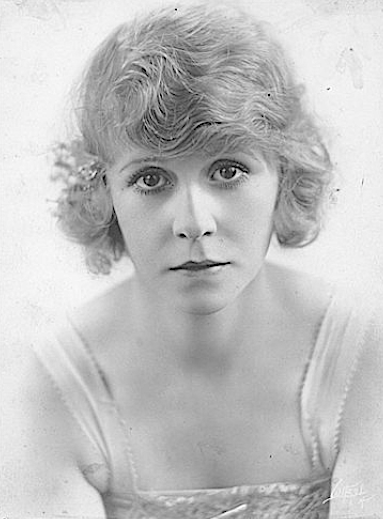
What became of actress Frances “Frankie” Burnham was a mystery for a long time. Her family could offer no help. They were even unsure what happened to Susie Burnham, her mother, who left her rural Missouri home and never returned.
Hollywood asked the same questions. Her opportunity for a big splash came when she landed the lead in Lorelei of the Sea (1917). Her reviews were mixed, but her big splash on the silver sheet turned out to be nothing more than a ripple. She vanished in 1919.
What became of Frankie Burnham?

Frances Burnham
The actress with golden hair and big bright eyes was born in Los Angeles on April 19, 1895, to Frank and Susanna (Carr) Burnham. The mysterious Frank Burnham came from either Massachusetts or Maine, no one knows at this point. Susanna, or Susie, hailed from Missouri. She lived there long enough to grow up and get out.
Susie spent the Gay Nineties wearing wedding dresses. Her first husband was Oscar Louis. This union produced Dean, born in Kansas in 1891. Susie made her way west and had a quickie marriage to Frank. Little Frances came into the world. In 1897, Susie became Mrs. Ernst Vogel and soon the mother of two more children, Ernest and Violet, born in 1899 and 1906.
In 1915, about the time Frances was breaking into films, Susie was breaking in a new husband, Everette Scates. Frances had been in films a few years when she was tapped to play the lead with Tyrone Power Sr. in Lorelei of the Sea (1917).

The cast and crew shot the film in Kalem’s old studio in Hollywood and in the islands off Santa Barbara. Lorelei (Frances) lives by the sea. As a child, she was taken in by Paul (Power) and raised as his own daughter. The drama comes when Peitro (John Oaker) and Dorian (Jay Belasco), who washes up on shore, vie for Lorelei’s affections.
Reviews of Frances’s work as Lorelei were mixed. She was everything between a “poor excuse of a star” to carrying her role “with a true dramatic touch.”

Frances had a leading role with George Walsh in On the Jump (1918), a World War I comedy. After a Western and two Lois Wilson films, Frances disappeared from the screen.

Frances Burnham
On July 10, 1920, Frances married Noble Sheldon, an Ohio hardware salesman.

The Noble Sheldons lived in this house at 4537 Prospect Avenue in the Los Feliz area of Los Angeles.
In early 1924, Frances became ill with pulmonary tuberculosis. She went for treatment at Pottenger’s Sanatorium in Monrovia, where she died from the disease on July 10, 1924. She was only 29 years old.
Frances Burnham rests at Forest Lawn (Glendale).

Pottenger Sanatorium


Close Ups on Fade Outs: Christine Mayo
I’m starting a new series within this blog, Close Ups on Fade Outs. I love writing books about early Hollywood and sharing my experiences with you through this blog. In all honesty, however, I have to say that the research into my work is what keeps me stimulated. In recent years, I have dedicated a lot of time to tracking down those early actresses who seem to have slipped away from film historians and enthusiasts. They have disappeared into the dusty past. There are questions marks where their death dates should be. What became of these ladies after their careers were over and where and how they spent their last days is what keeps me interested in what I do. Call it a fascination with necrology or an obsession with tying up the loose ends of someone’s life. Whatever it is, the yearning keeps me returning to dusty paths that lead back to the early days of filmmaking. Come with me!
Christine Mayo
Born: December 25, 1883, Jersey City, NJ
Died: January 9, 1961, New York City

The early screen vamp was born Christine Maier on December 25, 1883, in Jersey City, New Jersey, to Gottlieb Ludwig Maier and Christine M. Stumpff, both Germany immigrants. She was the first of three daughters. Ann was born in 1885 and Barbara Louise came along two years later.
Christine had the talent for show business. She was trained as a singer, but went on the stage after losing her singing voice. Her first theatrical experiences were in Excuse Me and Seven Keys to Baldpate.

The actress became an early proponent for a fund to support fellow actors. In 1914, she introduced a plan that would endow beds in hospitals across the country for those in her profession stricken with illness far away from home.
“I do not know just how many deaths occurred in the profession last season from pneumonia alone,” Christine said, “but from newspaper accounts I should judge there were at least 50. With few exceptions the sufferers were compelled to go to New York for treatment, and exposure en route was the reason given for their deaths.”

Christine made her film debut for Ramo Film Company. She was billed as Miss Mayo in The War of Wars: Or, The Franco-German Invasion (1914), the first film released in the United States that concerned World War I.
Christine then worked for Ivan Film Productions, where she starred in A Mother’s Confession (1915), using the name Chrystine Mayo. Ivan Abramson knew he had his Maxine when casting A Fool’s Paradise (1916). Christine plays a conniving gold digger on the prowl for a rich husband. Motography noted that Christine’s Maxine was a “character role most difficult to conceive.”

Christine Mayo in A Fool’s Paradise
In Who’s Your Neighbor?, Christine plays a prostitute, who, during a reform movement, is forced from the red light district to the better parts of the city.

By 1917, Christine was credited with making the expression “vamp” a “colloqual slang in the English language.”
Off screen, she was anything but an evil seductress. While promoting her films on a tour of 30 American cities, Christine recruited troops for service in World War I and sold Liberty Bonds. Her service did not go unnoticed. She received a gold medal representing the American flag from the hospital corps and was one of the first women of the stage to be awarded the right to wear the button of the Liberty Legion.

Christine’s film career, which consisted of roughly 30 films, extended into the mid-1920s. She had good roles and she did good work for such companies as Fox, Metro, and World Film Corporation. She appeared with John Barrymore in Raffles (1917) and Lon Chaney in The Shock (1923), in which she played Chaney’s underworld boss, Queen Ann.

Christine in The Shock
After her work in films, Christine did some theatrical work. For a time, she lived in Boston, where she managed the Scandia Jourde and Slattery’s beauty salons. There is no indication the former actress ever married. She remained close and devoted to her sisters.
Later in her life, Christine returned to New York City. She lived in a Gramercy Park apartment at 242 East 19th Street with her sister, Louise.
She died on January 9, 1961, at University Hospital of natural causes. Louise died the following year.


Viora Daniel: The untold story of a film comedienne, world traveler, and ‘bank sitter’
By Michael G. Ankerich
Maude Cheatham, writing for Shadowland in 1920, predicted stardom for the actress she had just interviewed on the Lasky lot.
“With her beauty, her vivid imagination, her sweet, girlish enthusiasms, and hopes, Viora Daniel promises to become a favorite twinkler,” wrote Cheatham.

The day Cheatham arrived on the set, Viora was in the middle of a scene with Roscoe “Fatty” Arbuckle. They were filming Arbuckle’s latest film, The Life of the Party (1920).
“I saw a slip of a girl whose vivid, sparkling face was framed in dark curls which were caught up in a huge bow. The frilly skirts just touched the round, bare knees, while pink socks and Mary Janes completed her ‘little girl’ costume.”
When lunch was called, a nervous Viora hurried over the Maude. She was being interviewed for the first time. Viora Daniel was living the dream.

Viora, who sometimes spelled her name with an “e” (Veora), was a California girl, born to Roques and Alfie (Stiner) Daniel in San Simeon on January 24, 1902. She was the second of three children. Wildy was born in 1899; Roques Jr. came along in 1904.
The Daniel marriage went on the rocks in 1906 when Alfie filed for divorce, accusing Roques, a farm laborer turned saloon keeper, of desertion. Viora went with her mother; Wildy and Roques stayed with their father and his mother, Guadalupe, an immigrant from Mexico.
In April 1912, frustration over a doctor bill he received sent Roques into the late night. He confronted Dr. Henry N. Freiman in his San Luis Obispo office. The two argued. Roques pulled out a revolver and fired. Dr. Freiman was killed instantly. Roques then turned the gun on himself and fired a bullet through his brain. He was a corpse by morning.

It’s not clear where Viora spent her teenage years or how she came to Los Angeles. Early publicity suggests that she grew up and went to college in Idaho. There she met Lorrie Larsen, a young woman from Norway. The two became fast friends and, in time, found their way to Hollywood.

Viora and Lorrie Larsen lived in this apartment house at 680 Witmer Street when they first came to Hollywood.
While Viora was away on a visit, Lorrie found work as a movie extra. When Viora returned, she met casting director Louis Goodstadt. He gave her the break she needed.

Famous Players-Lasky took her on and used her in small, supporting roles with Ethel Clayton and Harrison Ford (Young Mrs. Winthrop), Robert Warwick and Lois Wilson (Thou Art the Man), and Bryant Washburn and Margaret Loomis (The Sins of St. Anthony). Her big opportunity came when she was cast as Millie Hollister in The Life of the Party, a feature film starring Fatty Arbuckle.
Arbuckle put his slapstick on hold to play a respected attorney who runs for office as a reform candidate against local machine politicians. Millie, lowly secretary for a local charity organization, joins him in his fight. In the final reel, Arbuckle wins both the election and Millie.

Viora and Fatty Arbuckle in The Life of the Party
Viora and the comedian had a good rapport from the start. “Roscoe is so funny, and a darling. In fact, the whole company are such fun, and they all help me in every way they can,” Viora said. “I don’t always know what to do, and Roscoe will say, ‘Now, just what is it you want Miss Daniel to do in this scene?’ and the director will explain it all over again.”

To appear with Arbuckle was a dream come true for the struggling actress. “I remember I used to go and see Roscoe’s films,” Viora said at the time, “and how I did enjoy them, but, of course, I never once dreamed that I would ever be playing with him. It is all so wonderful — sometimes I wonder if I’ll wake up and find it isn’t true.”
Viora’s time with Famous Players-Lasky was short. After The Easy Road (1921), she left the studio.
She appeared in a Max Linder short, Be My Wife, then signed with Christie Comedies. The studio was intent on molding her into a film comedienne.

The glamorous Viora Daniel
Her work at Christie was steady, but not very challenging. The plots bored her. Viora wanted more depth in her roles. In one, That Son of Sheik (1922), she is a starstruck teen who becomes obsessed with her film idol, Ruleoff Vassalino. Her boyfriend, Neal Burns, plots with her father to bring her back to earth.

An ad for A Pair of Sexes with Neal Burns
In her private life, reality set in. In September 1921, she toyed with the idea of marrying and leaving her profession. It’s one or the other, she said. Her best friend, Lorrie Larsen, had married actor Harris Gordon in late 1920 and moved on.

Viora left films in 1922 to tour in vaudeville. In the mid-1920s, she married bank cashier Wayne Casady, the son of a bank president. She flirted with a return to films. After making three films in 1927 for independent studios, Viora fulfilled a life-long dream. She set sail and traveled with world.
Since childhood, Viora held a fascination for the Orient. Her dressing room at Famous Players-Lasky was adorned with treasures from lands beyond the Pacific.
“I’m crazy about the Orient,” she told a visiting reporter, “and I love every one of these things. My greatest joy is to prowl about the curio shops, and I know if I ever get to Japan or China, I’ll become light-fingered and probably be put in jail, for I’ll never be able to control myself with all those lovely things about. ”
Viora toured Orient in 1928 and set up residence in Hawaii. Somewhere along the way, her marriage fell apart. When she arrived in Los Angeles in 1929, cameras were there to click for her. Snuggling with her miniature pooch, Viora, draped in fur and looking like a million bucks, posed for photographs. Since her acting days, she gushed, she had sailed the world, exploring little known countries. She’d just wrapped up a trip into the interiors of China and Japan and was soon returning home to Hawaii.

Viora returns to Los Angeles
Several years later, Viora was back in Los Angeles and not as chipper as before. Sailing the high seas had apparently drained her finances. To keep herself afloat, she reconnected with Wayne Casady, her ex, reminding him that he still owed her over $3,000 in back alimony.
When private and discreet attempts to collect from Casady failed, Viora took her squabble to the press — and to Casady’s place of work. She found herself a seat in the lobby of the Wilshire National Bank, where Casady worked as a bank officer.
She filed suit against her former husband in September 1932. She won the case but had little luck collecting the money. Viora was back in the bank lobby in February 1933. For four days, the former actress sat. The bank declared her a nuisance and secured an injunction to bar her “sit in.” A week later, her “bank sitting siege” ended by court order.
Rather than continue her fight, Viora opted for marriage and more world travel. She married Scottish shipping manager Harold Gourlie. The Gourlies lived in Scotland and the Philippines and made frequent trips to the United States. Friends had trouble keeping up with her.
When Gourlie died in London in 1958, Viora returned to Los Angeles. She was married briefly to Silas B. Adams in 1972. Viora settled into an apartment at 11063 Ophir Drive in the early 1970s.

Viora Daniel lived at 11063 Ophir Drive when she died in 1980.
The former actress fought breast cancer for six years. The disease eventually spread to her liver. She died at home on May 9, 1980. Her final resting place is Forest Lawn Memorial Park (Glendale).

Viora’s time on the silver sheet was short. Maude Cheatham’s predictions that Viora would become a “favorite twinkler” fell short. Sadly, the fast strides the young actress made early in her career fizzled all too soon.

Hair Pins and Dead Ends, Ankerich’s new book, on the horizon
Relax, friends, I have not pulled a Howard Hughes or Doris Duke on you and slipped into seclusion on some exotic island in the Pacific. If I ever became a recluse, it would be in Manarola, Italy, but that’s another story.

Michael in Manarola, 2013
I am hunkered down and working on my next book, Hair Pins and Dead Ends: The Perilous Journeys of 20 Actresses Through Early Hollywood. This book is a companion volume to Dangerous Curves atop Hollywood Heels, which was released in 2010.
Hair Pins and Dead Ends tells the stories of 20 young women from all walks of life who, despite the odds against them, rose above thousands of other hopefuls to enjoy various level of success in films.

Like Dangerous Curves, I selected the names for this book because I wanted to know more about their struggles in Hollywood. Some were well known and it was fairly easy to research their lives. Others existed only in fragments, a mention in Variety here, a photo in Motion Picture Classic there. Family members and public documents brought these women back to life.
I wrote extensively about Barbara La Marr in Dangerous Curves, from her birth in 1896 to her death in 1926. She lived life so fast that I thought we should slow the action down and focus on her formative years, her life before films.

In Hair Pins and Dead Ends, I piece together those years using La Marr’s own diary and the unpublished memoirs of Robert Carville, an early lover. I discovered that the “girl who was too beautiful” was really the girl who was too unhappy.

Mona Lisa
Mona Lisa was equally as mysterious on the silver sheet as she was on canvas. Like Barbara La Marr, this shadowy figure from silent films lived fast. Her publicity campaigns and brushes with the law made her private life more interesting than any films she made.

Margaret Gibson’s 1965 deathbed confession brought her name back to life. A neighbor who had been with Margaret as she lay dying recalls her confessing to the murder of director William Desmond Taylor. While playing virginal maidens on the screen, Margaret drifted into Hollywood’s underworld.

Marjorie Daw
Both Marjorie Daw and Virginia Lee Corbin had mothers who brought their families to Hollywood in search of fame in the flickers. Marjorie’s mother died in 1917, leaving the 15-year-old to raise her teenage brother.

Virginia Lee Corbin
By the time Virginia could crawl, her starstruck mother was pushing her into the spotlight. Virginia married young to escape her mother’s talons, but found it difficult to let go of her career.

Alice Lake
Alice Lake, Helen Lee Worthing, and Lottie Pickford drowned their broken dreams of Hollywood in booze. Alice clung to a career long gone.

Helen Lee Worthing
Helen rebounded from mental illness and suicide attempts, but her major sin in life was falling in love with the wrong man.

Lottie Pickford
Lottie never gave a damn about much, preferring to party life away in the shadow of her sister, Mary, America’s Sweetheart.

Sisters Katherine McDonald and Mary MacLaren were the Olivia de Havilland and Joan Fontaine of silent films. They were as different as night and day. Early tension in their lives led to a rift that never healed. Katherine struggled with alcoholism.

Mary MacLaren
Mary, referred to (by some) as a crazy cat lady, spent her last days in her dilapidated home in the heart of Hollywood.

Fontaine La Rue
After a tragedy in their native land, Fontaine La Rue and her mother came to the United States. Fontaine soon married and became the mother of three children. Defying the odds against her, she found her place in the motion picture industry as a comedienne and vamp. I devoted a post to Fontaine when I was searching for her story. I knew bits and pieces, but lacked the critical piece needed to put her life together. Her family got in touch and filled me in. Her remarkable story is ready to be told.

Belle Bennett
Belle Bennett became a teenage mother while appearing in her family’s traveling circus. Once in Hollywood, she denied her motherhood, passing her son off as her brother. Ironically, an accident took the boy’s life, just as Belle was preparing for the mother-of-all roles in Stella Dallas (1925). Belle was stricken with cancer and died at the dawn of talkies.

Edwina Booth
While Edwina Booth survived the mysterious illness she contracted in the wilds of Africa while on location for Trader Horn, the beautiful blonde was never the same. She disappeared from public view. For years, the world believed she had succumbed to her illness. Edwina, comfortable in her seclusion, never came forward to prove them wrong. Her family sheds light on her illness and later life.

Marie Walcamp

Florence Deshon

Evelyn Nelson
Marie Walcamp, Florence Deshon, and Evelyn Nelson escaped illness, heartbreak, and disappointment by bringing down the curtain on their own lives. Suicide, it seemed, was the only way to set themselves free.

Jetta Goudal

Valeska Suratt
Jetta Goudal and Valeska Suratt committed professional suicide through out-of-control temperament and typecasting.

Peggy Shannon
Peggy Shannon came to Hollywood as a successor to Clara Bow, The It Girl, who had broken down from too much “It.” In time, Peggy lost her own way. Hollywood was particularly cruel to this former showgirl and helped her realize that, while she might have been a replacement for Clara, she was a poor imitation.

Lolita Lee
Lolita Lee, a struggling dancer and movie extra, was hired to replace Barbara La Marr in the film Barbara was making when she finally burned out. Being an imitation of or replacement for anyone never guaranteed success. Lolita soon vanished.
Look for further information about the release of Hair Pins and Dead Ends.
Butterfly McQueen: My conversation with the actress and activist
By Michael G. Ankerich
When the lady on the other end of the line started talking, I knew it could be only one person: Butterfly McQueen, the actress who played Prissy in Gone With the Wind (1939). She was calling collect from a phone booth in Harlem — she had no phone in her apartment. I was interested in interviewing her for Hollywood Studio Magazine‘s 50th anniversary of the classic film’s release.

Butterfly alerted me that she would phone
She was enthusiastic about her recent activities, including community activism and a trip to Africa. Because I was unable to make the trip to New York , Butterfly suggested that we do the interview by mail. I would send her the questions. She would answer the questions in writing and return the pages in a self-addressed, stamped envelope I had enclosed.
Twenty-five years ago, I was more interested in hearing about her work in films than her later activities. As I reread her responses to my questions about community activism and racism these many years later, I have a greater appreciation for the work she did late in life and her convictions about how we can have a better world. Sadly, I don’t think we’ve arrived to what Butterfly refers to as a “haven for each and every individual of the entire universe.”
Here is how our conversation unfolded.

Butterfly McQueen
Michael: Were your ambitions to become an actress?
Butterfly: Never. However, one day in our backyard in Tampa, Florida, I picked up an old magazine of the “photoplay” type and a strange premonition came over me, letting me know that some day, I, too, would be among those photos I saw in that magazine.
Michael: What was your first experience on the stage?
Butterfly: My first experience in the professional theater was in Broadway producer George Abbott’s Brown Sugar. I was 26 years old.

Michael: How did you acquire the name Butterfly?
Butterfly: A friend, Ruth Moore, named me Butterfly because I told her I had danced as a butterfly in Venezuela Jones’ production of A Midsummer Night’s Dream.
Michael: What stage experience did you have prior to Brown Sugar?
Butterfly: The amateur theater was always by pastime hobby. I first began as a child in church, reciting books of the Bible. In Augusta, Georgia (where my mother was born and raised), every Friday at chapel, I recited or sang, as many others did. Although I am now an atheist, I still prefer performing in church as I did two Sundays ago. The church has a “ready made” audience and platform. I have always enjoyed writing and practicing the piano and guitar. My love of music was nurtured by my mother and my attendance in Sunday School.
I hope some day, our churches will serve our communities each day of the week and have teachers for an everyday existence, rather than preachers for a dubious hereafter.

Vivien Leigh and Butterfly McQueen (as Prissy) in Gone With the Wind
Michael: How did you get the role of Prissy in Gone With the Wind?
Butterfly: Newspaper critics who saw me in Brown Sugar, Brother Rat, and What a Life gave me such excellent notices and agents signed me to go to Hollywood.

Butterfly and Vivien Leigh
Michael: Did you realize that a classic was being made during the production of Gone With the Wind?
Butterfly: I don’t believe any of the cast did. We were all ‘high quality’ actors doing our very best.
Michael: Do you have any lasting impressions of Clark Gable and Vivien Leigh?
Butterfly: Everyone in the cast with whom I was involved were ladies and gentlemen. Miss Leigh had the hardest part to do. She was always polite, as everyone was. The full year I never heard even a “darn.” One day, Mr. Gable’s script was late and I think he wanted to curse, but because I was at his side, he only gritted his teeth.

Michael: How did you feel about your role in the film?
Butterfly: Mr. Gable said to me once (the only time he had cause to speak to me), “What’s the matter, Prissy?” His tone of voice implied that “if they are not nice to you, you let me know.” Mr. Gable asked me, “What’s the matter, Prissy?” I was so unhappy about my role and was forever whining and crying out loud. I didn’t answer Mr. Gable. I’m sure I stopped whining. I could tell anyone how hurt I was that I was not to show what great progress we blacks had made, yet, in 1937, I had to be a stupid, backward ignoramus.
Producer David O. Selznick understood and sympathized with me. The black wardrobe woman forgave my tantrums. She, too, seemed to understand my hurt. Hattie McDaniel (Mammy) said, “You’ll never come back to Hollywood!! You complain too much!!” Mr. Selznick put me in two more movies (Since You Went Away and Duel in the Sun).

Hattie McDaniel as Mammy
Michael: What are your thoughts today about your role as Prissy, almost 50 years later?
Butterfly: Oh, thank goodness! Would you be writing me if there had been no Prissy? I very doubt it! Would I be in a very beautiful studio apartment? Would I have fans all over the world? I think not. My past misery has brought me present joy and well-being.

Butterfly with Joan Crawford in Mildred Pierce
Michael: I have to ask you about working with Joan Crawford in Mildred Pierce.
Butterfly: In Mildred Pierce, Miss Crawford was more down to earth than she appeared when I was with her in The Women.
Michael: Of the many motion picture legends you worked with, do you have several who stand out as exceptional?
Butterfly: I respect all of the “greats.” One has to respect the so-called “greats,” because they have kept level-headed, which isn’t easy to do in this hypocritical America (smiles).
Michael: In 1975, you received a degree in political science.
Butterfly: My degree is liberal arts. Each semester one is allowed to change one’s major. Only one semester did I study politics. Other semesters I have studied music, art, introduction to law, and other subjects. It was not difficult to secure credits, because after I made money in G.W.T.W. and had time, I went to college as a hobby. I was not serious about a degree until I had a desire to be a recreation center director.

Butterfly McQueen writings
Michael: Tell me about your community activism. When did you begin to work in the community?
Butterfly: I suppose when I saw how down hill our appearance began. I try to keep beautiful neighborhoods. There are many more duties, but I chose this one because it is most gratifying, I think. At voting time, I work, but I don’t talk about politics. I, a registered Republican, have crossed over and voted for a beginning Adam Clayton Powell Jr. and a Jimmy Carter.
Michael: You mentioned to me over the phone about going to Africa last year. What was the purpose of your trip?
Butterfly: I went because my roots are there. I found out in Ghana that children wanted pencils and paper. I’m sending them the same, thanks to my fans. I’m trying to achieve dual citizenship.
Michael: Do you still receive mail from your fans?
Butterfly: Yes! Mail is always very heavy. I feel I must continue to be worthy of people’s admiration, such as keeping myself educated and caring for others. Each one of us was born to carry on the good which we have inherited.

Butterfly responds to my questions
Michael: How do you want to be remembered, for your work in entertainment or your community activism?
Butterfly: Both! Seriously, Mr. Ankerich, I would like to be remembered as the person who advised her American blacks that if they are as dark-complexioned as I am, they should be very happy and pleased that they have built a harmonious haven for some white and light-skinned people. Isn’t it ridiculous, Mr. Ankerich, that there is no place where there is a welcome mat for all Europeans? Let America be that place. We of African descent (if one is dark-skinned) should build Africa as we have helped to build America. Civilization began in Africa. Why not perfect it there?
When I was a child, I was not told of prejudice. I learned of prejudice when I came north. The first I heard of social injustice was when we sang, “They’re hanging men and women for ‘The Wearing of the Green.'” Black-skinned people, such as I, would give more space for white and light-skinned people. I do not want America to continue being hypocritical about wanting back-skinned people here, because I know I’ve been helped mostly by those of lighter skin than I, in spite of my being industrious and intelligent.
Two Sundays ago, I explained to a church audience about why I keep a low profile. I know who has helped me: the Margaret Mitchells, the David O. Selznicks, and light- and dark-skinned people of my own race. However, I would not want anyone to go through some of the unpleasantness that many of us Americans suffer, white and black. Some people are as honest as the black bus driver here in Harlem who told me to go sit in the back of the bus because I was too black to sit up front. The Polish lady who told us (my mother and me) she was fighting us because we were black colored. I told her I would not have moved into the neighborhood if other colored people had not already been living there. I looked around, and sure enough, my mother and I were the blackest-skinned.

Handwritten comments by Butterfly McQueen
Another honest American was the politician in Queens, who, on America’s 200th birthday, said that all people were welcomed here except the black women. They should go back to where they came from, he said. No one said a word until the Japanese said our minorities hinder America, and I agree in part. America, white and light-skinned America, could progress faster if it didn’t stop to try to keep us black-skinned people in “our place.” Having said this, Mr. Ankerich, I’ll continue trying to make America the Heaven I know she is for many, in spite of how I’m treated by some people. I’ll continue wishing certain white and colored (light-skinned) people stop using prejudice to make money! I wish you could see how I’m smiling and have no animosity when I say that, in America, hypocritical America, poverty and prejudice are big business for some people in both the white and black race.
In my daily good wishing (praying), I want a haven for each and every individual of the entire universe.
Mr. Ankerich, please let my fans know that their mail is sometimes late because I’m only here a few months of spring and summer. I’ll rush out and mail this now. Continued success, Mr. Ankerich.

Do you want to know more about Butterfly McQueen? Read Stephen Bourne’s biography, Butterfly McQueen Remembered.
Butterfly died several days before Christmas in 1995. She suffered second- and third- degree burns over 70 percent of her body in a house fire in Augusta, Georgia.


Ginger or Mary Ann? I must confess
“If you could be marooned on Gilligan’s Island, toward which character would your raging teenage hormones point you: Ginger or Mary Ann?” When I was in high school about 100 years ago, that was the question the guys asked each other. As I recall, most said the wholesome Mary Ann. The sexy and sultry Ginger Grant, they giggled, might be too much for the inexperienced to handle. I kept my mouth shut.

When I heard about the death of Russell Johnson yesterday, the actor who played the Professor in the famed sitcom of the 1960s, I thought about Ginger Grant and Mary Ann Summers. Sadly, Tina Louise and Dawn Wells, the actresses who portrayed the island beauties, are now the only living cast members remaining from Gilligan’s Island. Where has the time gone?

Tina Louise
I pulled my files on these two lovely ladies to see what contact I’d made with them over the years.
I heard from Dawn Wells in the early 1980s. I feel the same disappointment I felt when I first opened the envelope. Her PR folks sent a disappointing form letter with a printed signature.

The printed form letter
The accompanying photograph was nice, but it also had the dreaded printed autograph. Drats!!

I’m not sure what I said 30 years ago, but when I pulled the photo from my files this morning, I responded, “Crapola,” a mild form of cursing I use when I don’t want to say what I really feel.
Tina Louise was a different story. I wrote to her somewhere in the early to mid-1980s. I sent her a photograph and asked her two questions: When you were modeling in college, did you ever expect you would find fame in films and on television? Did you know Marilyn Monroe? Here is her response.

Tina Louise’s response to my questions
I transcribe for you: “1. No I didn’t because I was to(o) young to imagine I could and was happy just doing what I was doing. 2. Yes I loved Marilyn but I never met her but many friends of hers.” I assume Tina meant that many of her friends did meet Marilyn.
Here is the photo she signed for me.

Of the hundreds, probably thousands, of hours I spent in front of the television growing up, there are few moments from those shows that I remember. The episode where Tina (as Ginger) sings I Wanna be Loved by You is the one that sticks in my mind. Ginger is luscious, sultry, and stunningly beautiful. I loved her hair. I adored her gowns. I coveted her boa.
When my classmates asked which I character I most wanted to make out with, I kept quiet. Now, decades later, I can confess. I didn’t want to have sex with either Mary Ann or Ginger.
I wanted to BE Ginger Grant!

The gorgeous Tina Louise
Author Stephen Michael Shearer: The Interview
I’ll never forget the encouragement that author Stephen Michael Shearer gave me when I was writing my Mae Murray biography several years ago. His Hedy Lamarr biography had just been
 released
in hardcover. Although he was busy doing publicity for the release, he
made time to give me a call and talk through some important points to
remember when writing a life story.
released
in hardcover. Although he was busy doing publicity for the release, he
made time to give me a call and talk through some important points to
remember when writing a life story.
When his latest book, Gloria Swanson: The Ultimate Star, came out last fall, I was anxious to learn what he uncovered about the legend. I took the book on my travels to Italy in October and learned more about Gloria during those two weeks than I had read 30 years ago in her own memoirs, Swanson on Swanson. After reading her book, I thought I knew all there was to know about the “ultimate star.” I was wrong!
Gloria Swanson: The Ultimate Star turns the spotlight on one of the most fascinating personalities of the 20th century. Great job, Stephen. Miss Swanson was overdue for her closeup!
I was anxious and hopeful that Stephen would spend a little time talking about his latest book and his other important works. Here is how our conversation unfolded a few days ago.

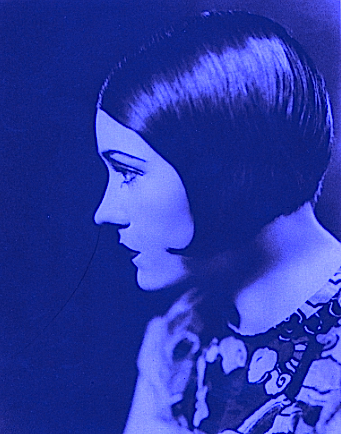
Glorious Gloria
Michael: Gloria Swanson has been gone almost 30 years. Why has it taken so long for someone to write an in-depth accounting of her life and career?
Stephen: I think it is because for all these years since Swanson’s own book came out, many film buffs and quasi-historians have assumed it to be the definitive account, the last word. Swanson wanted her take on her history to be the Holy Grail, her intimidation reaching out from the grave. Most authors would not touch Swanson’s life after Swanson on Swanson was published – her assumed “authority” just simply prohibited contradiction.
Michael: What was it about Gloria that first interested you enough to devote a biography to her?
Stephen: As a biographer you know that there is never a “final” word about one’s life and/or career, and certainly with an autobiography such as Swanson on Swanson there remained many gaps and holes left untapped, not to mention untold questions. Swanson’s immense ego gave me rise to ponder the truth about her life and work. Definitely in her tome her accuracy on her work was for the most part correct.

Gloria Swanson in Sadie Thompson
Yet the circumstances revolving about her life, her own personal motivations, her career, and her “self,” fascinated me. Once I spent the first of several weeks in Austin, Texas, sifting through her hundreds of boxes of her archives which reside at the Harry Ransom Center, I realized a need to chronicle her life and career properly, with objectivity and, yes, passion. I eventually fell under her spell, and came to love her (as I have with all my subjects) once I felt I was getting to know her.
Michael: I love what Gloria said about her mother. ”We could look at the same window and never see the same things.” What impact did her mother have on Gloria’s life?
Stephen: Swanson was a “do-er,” and overachiever. Her mother was very needful. Quite like today’s Lindsey Lohan and Jodie Foster, Swanson (who also adored her father) took on the mantel of provider and support for her mother at an early age, a not uncommon act for daughters of divorced parents. Swanson wanted to please her mother and in one telling letter I found amongst her papers (so diligently archived by her friend Raymond Daum in Texas) Swanson reprimanded her mother Addie (after she had remarried without informing Gloria) suggesting that now she was the parent and her mother the impulsive child. The dynamics between Swanson and her mother were not much different from countless others. What made the relationship interesting was that Swanson realized their differences, and kept a financial and emotional “control,” if you will, over her mother’s personal and public image.
Michael: Her marriage to actor Wallace Beery was fascinating. You bring him to life in your book in a way that made me take a second look at this actor. Beery, you write, “possessed an animalistic manly and muscular body, he harbored a “no-nonsense approach to sex” and that he was strangely, sensuously attractive to you girls.” What a description! Was he really a hunk and irrestible to women?

Wallace Beery and Gloria Swanson
Stephen: By all accounts at that time, yes. Just look at his frame, those biceps, and that ruggedly manly body in off-camera pictures of him from the 1910s. What he lacked in intelligence, compassion, manners, grace, cleanliness, and moral and social acceptability, Beery certainly made up in talent and virility. He was crude and vulgar, and remained so the rest of his life. But Swanson too was uncultured and ignorant then. And what possibly attracted them to each other – she had an equally strong libido even as a teenager. So it is totally not unreasonable to understand her attraction to an older man who enjoyed the carnal things in life as much as she. What possibly broke them up was that Swanson wanted finer things for her future, and Beery remained fixed.
Michael: Two interesting quotes have been used to describe Gloria Swanson. Director Allan Dwan said, “Gloria Swanson had the body of a woman and the mind of a man.” Her daughter said she was a feminine woman with a masculine brain. Do you think she thought of herself in those terms?
Stephen: I would definitely say that after a few really hard knocks in life (her marriage to Beery included) some semblance of reality must have settled in on Swanson and her outlook on life and in particular with her dealing with powerful (and weak) men. In Gloria Swanson: The Ultimate Star I wrote that she categorized men into definite types – “daddies” to support and take care of her (little Glory); lovers to play with and satisfy her immense ego and libido; gay comrades to appreciate the same desires she felt for attractive men; and “the enemy” – strong and powerful men she felt compelled to challenge. In that respect, professionally at least, she was in her element.

Like Lucille Ball a generation later, Swanson’s professional dealings within the Hollywood caste system were met with resistance, especially by “The Pinochle Club” (the then select group of silent film producers). I thoroughly, however, do not feel that Swanson saw herself in that light. Always immensely feminine in private, she would gird herself when she dealt with the industry powers. She never felt herself inferior (perhaps she possessed that strength because of her 4’11” height), and was oftentimes blindly unaware of her, excuse me, shortcomings, one of which was an absolute conviction she was always correct.

Michael: What was it about Gloria Swanson and children? Don Gallery, the son of Barbara La Marr, told me that Gloria would stay with his family (ZaSu Pitts adopted Don after his mother’s death in 1926) when she came out to California from New York. Don said that Gloria didn’t like kids and used to pinch him and his sister.
Stephen: Swanson and Pitts were great friends. (Both had worked under Erich von Stroheim, don’t forget.) They often attempted to develop collaborative projects which might suit them, but their public personas would not allow. Her own children Gloria found exemplary. But other children she found she had little interest in. Perhaps because she always felt her own childhood was drab and uninteresting, Gloria also found there was little in common with nurturing and caring hands on, when her own life, she felt assured, was so busy, so fascinating, and all consuming. Nowhere in my research did I find references to Swanson and her honest feelings about children. (She wrote in her memoir so overly poetic about her ecstasy of motherhood, which I found deeply suspicious, before immediately and abruptly segueing into the latest fashion trends or men finding her immensely sexually alluring.) However, there exist great publicity photos Swanson insisted upon having made of her and her girls and son which show she might have found them very useful to exploit her image to middle class audiences.

Michael: It’s funny about fame. Bette Davis was often referred to as an actress, while Joan Crawford epitomized a Hollywood star. You titled your book, Gloria Swanson: The Ultimate Star. From your vantage point, looking over her whole life, do you think of Gloria as an actress or star? Did her looks and glamour get in the way of her ability as an actress?
Stephen: I do not find anything funny about fame, Michael! It is a bitch. I traveled for years with Patricia Neal, who truly enjoyed her well-deserved celebrity. But I also saw how it distanced her from some minor realities of real life. Immense concentration of one’s public image is always foremost in daily preparation, social intercourse, and appearance. A little goes a long way, at least for most of us mortals who have not lived the film studio culture. At the end of the day, one is alone, the star image firmly planted in the heavens, stars distanced by their own radiance. Fame is exhausting. And it is a trade-off….
In answer to your question, Swanson was one of the Hollywood handfuls who actually created celebrity and stardom through the use of the film and publicity. By luck, determination, and self-assuredness, Gloria Swanson was first and foremost a STAR (with capital letters please!) who achieved public acceptance through the film medium. It granted her money, recognition and privilege which she always felt she deserved. By her own capricious nature she lorded it over her contemporaries and was highly disliked overall within the film community (and don’t forget too that personal and professional jealousy are part of the actor’s nature). When her image waned and times caught up with her, her career suffered. Despite what she might have written in her own book, she only became a true actress (even after two early Oscar nominations) after she learned a strong degree of professional discipline and acting technique via the stage. When Sunset Boulevard came along, and all the elements – the script, the leading man, the director, the sets, etc. – were brilliantly right in Heaven, she was more than prepared to give what I believe to be THE most sensational comeback in motion picture history. Gloria Swanson had become an actress.
Michael: How many films of Swanson did you view as you researched and wrote her biography? Do you have a favorite?
Stephen: Because my final manuscript of Gloria Swanson: The Ultimate Star was so lengthy, the editor felt we should not include the Appendix (Swanson’s complete film, theater, television, radio and recording credits which totaled another 50+ pages) so as to market the book affordably. (This Appendix can be downloaded off my website www.smsmybooks.com.)

A swedish advertisement for The Love of Sunya
I viewed every one of Swanson’s film in existence chronologically as I prepared the manuscript, including one last 1922 little epic Zaza, shortly before the book came out. (Many of the silent films are lost.) With Gloria Swanson I had to learn to appreciate objectively the process of silent film making and performance. Swanson truly possessed that “It” factor, that unexplainable gift of cinema magic, which her mentor Elinor Glyn wrote so rapturously about. In those silent films, Swanson is mesmerizing to watch even if she repeats the same techniques and physical mannerisms she repeatedly found precious. One simply cannot take one’s eyes off of her. Only a few of her silent films to me are memorable, as I wrote in the book. They epitomize why Swanson was such a great star. Only when sound came in (and she was quite acceptable and sometimes quite good in a few of her talkies) did her story lines, contract demands, and her absolute refusal to change with the times force her career to nosedive. After Sunset Boulevard, she was offered many a golden lost moment to continue her popularity juggernaut. But Swanson reverted to type, her own persona of herself destroying any opportunity to evolve and capitalize on her rediscovered fame. Pity for us all. Swanson’s retort was that the studios demanded she play “Norma Desmond” over and over again (which is VERY untrue). However, she very well could have played the part of Norma Desmond too well.

Gloria and her carnation
Michael: How did carnations become Gloria’s signature flower?
Stephen: Her ego, plain and simple. She used to use roses as if she carried a magic wand to accentuate her prominence in a room. Her small frame dictated to her that she needed to bring attention to herself physically. By swatting a long-stemmed rose (which evolved into a simple carnation – cheaper? – in later years) about in conversation, attention was always focused on her. Once at a social gathering which Swanson attended another not mentioned actress appeared with a long-stemmed unnamed flower in hand, batting the daylights out of it much to Swanson’s annoyance. Swanson left the party.
Michael: What is your opinion of Gloria’s memoirs, Swanson on Swanson? Truth, fiction, or somewhere in between?
Stephen: Like legions of film buffs for nearly 30 years, I believed Swanson on Swanson was the gospel. That is until I began to study her work and life. She did not write that book. Her last husband, William Dufty (Sugar Blues) did it as a wedding gift to her. (Others tampered with the manuscript before publication after Dufty left her over another man.) Dufty also ghost-wrote the much heralded Lady Sings the Blues, which is Billie Holiday’s “autobiography.” Holiday could barely spell her own name, much less write a book. But Dufty was a longtime friend of the tragic singer (she was his only child’s godmother), and he did the work. A gifted mimic (after he left Swanson his longtime partner, Dennis Fairchild, told me Dufty was a “ventriloquist”) he could channel speech patterns, wordage, the actual “way” Holiday and Gloria spoke. And for years, as with Lady Sings the Blues, I truly believed that Swanson had written her own book.

With daughter Gloria and first grandchild
She told her story as she wanted it to be remembered. Gloria superficially was always somewhat honest, especially about her career. But her image of herself, her outspokenness, her total concept of life was tainted by her convictions she was always right. And that leads to questions. Plus, as my research progressed, I found Swanson never took an objective viewpoint on anything and much historical accuracy and important factors of her life were trifled with or merely left aside.
Michael: How much cooperation did you receive from her family?
Stephen: As much as I needed. Children of celebrity are different. They suffer in ways we mere mortals cannot assume to understand. They were more times than not exploited. On display when needed, their parents voicing and demonstrating affection though they are never there, in reality so much of Swanson’s children’s lives was spent in the care of nannies, nurses and tutors. Gloria was always off filming, or in rabid pursuit of “romance” entrenched in her amorous affairs or “traveling.”
Daughter Michelle, in interview after interview, told of her seldom seeing her mother until she reached young adulthood. Swanson children were always sequestered off to private schools. All three grew into fine adulthood, producing normal, stable non-showbiz families. Gloria was an enigma they simply had to come to terms with. I believe I dealt fairly with Gloria’s heirs. They were rarely a part of their mother’s life, by her choice. She provided education and sometimes support to them as they became adults. Yet she rarely let them intrude in her social and professional activities.

Michael: Your first book was a biography of Patricia Neal, whom you interviewed extensively. How did the two of you become acquainted?
Stephen: Patricia Neal was a very close, dear friend for nearly 20 years. I met her when I lived in New York in the early 1990s. I was acting at the Nat Horne Theatre in the original off-Broadway play, Luigi Jannuzi’s The Appointment. (I originated one of the two male lead roles.) It won the coveted Samuel French Award that year. Patricia and Philip and Marilyn Langner came to a performance. Langner was the head of the Theater Guild. Afterwards, my partner, Michael, and I drove Pat to her apartment on the Upper East Side. We had a glorious time, became good friends, and things evolved from there. I have never been enamored or intimidated by celebrity. Certainly I am respectful of it, and I have my favorites. But as a struggling actor in New York, I worked with a few stars, and had even developed a varied and diverse group of actor friends. I waited tables to survive, and met many stars and celebrities, and found them to be normal folks, for the most part.

Stephen and Pat Neal
Patricia was a Southern woman born and bred, and with me, she felt she could be real. (Occasionally in later years when we would travel together and she was tired she would become “the STAR,” and I would gently remind her not to treat me as a secretary, but as a friend.) She could count on my being honest with her. She was always fascinated with the fact I wanted to know more about her career. She had to relearn her life after her debilitating stroke in 1965. So my coming up with facts fascinated her, as most of her other friends did not do the research I did. At any rate, we were always on the phone, dining out in the city, and keeping in touch. I went to her home on Martha’s Vineyard, and we were simply good friends. She would ask me periodically if I was ever going to do a book on her life. I once asked her why, and her reply was, “No one had ever asked her.” (She did write her own autobiography in the late 1980s As I Am.) I had published some reviews and did a fair amount of research for the Academy of Motion Picture Arts & Sciences.
After 9/11, when I lost 11 colleagues in Tower One, I quit corporate work and began Patricia Neal: An Unquiet Life. She opened up her archive, her files, her letters and pictures to me with the one stipulation, that I tell her story “warts and all.” I believe I did a proper job. Patricia agreed to travel with me to high-end venues (original book signing in New York, The National Book Convention in Washington, D.C., and some television interviews.) The book did well. I appeared with Pat in her last film, Flying By, in 2009, which co-starred Billy Ray Cyrus and the lovely Heather Locklear.
Patricia Neal was my friend, my muse. I miss her terribly.

Michael: Is it harder to write about someone you know personally, for example, Patricia Neal, as compared to Hedy Lamarr and Gloria Swanson, whom you didn’t meet or know personally. Compare the experiences.
Stephen: With Pat Neal, I had the great opportunity to talk with her about her life and career for a couple of decades. She graciously allowed me the wherewithal to her papers and memorabilia, and it was a glorious experience, a pampered and brilliant exercise for a first-time author. I became spoiled, for sure. When writing Patricia Neal: An Unquiet Life, I had to be very careful NOT to make it a “fan-based” book. They are more often than not none too truthful or objective, as you know. I truly had to search out negative comments and reviews of Patricia in particular because, aside from her numerous triumphs, in some of her most dreadful projects, she usually walked away with positive reviews. I fought to be objective when I dealt with aspects of her career.
I did not know Lamarr or Swanson. However, with both of their projects, I went to living sources, family in particular, friends and colleagues, to glean insight to these women. It is often not in the questions asked that is important, but in the answers given. To present the right questions and assimilate the answers properly is vital. (For Hedy Lamarr’s daughter, Denise, to tell me her mother, and Dirk Benedict, Gloria Swanson’s dear friend, to tell me she too, “would have liked you” meant, to me, that I was doing the work correctly.)

Hedy Lamarr, the most beautiful woman in Hollywood?
Michael: Your biography on Hedy Lamarr was just released in softcover. She was stunningly beautiful. Was she the most beautiful actress in Hollywood?

Stephen: When I was a young kid growing up in the South, I remember watching Tulsa’s KTUL-TV late night movies. When Hedy Lamarr was in one, I recall I could not take my eyes off of her. She mesmerized me so. I asked my late mother who she was, and I quoted my Mom in the Preface to Beautiful: The Life of Hedy Lamarr. However, beauty is subjective. It may emanate from within. I selected the title for my book for the fact that Hedy Lamarr was so much more than JUST beautiful.
There have, over the years, been many, many physically beautiful women in Hollywood – Gene Tierney, Greta Garbo, on and on. But by my taste in facial beauty, yes, Hedy Lamarr tops the list.
Michael: Before I read your Hedy Lamarr biography, the most I had read about her was Ecstasy and Me, supposedly written by the actress. Were you able to uncover the real story? Did she actually write it? How much of it was fact?
Stephen: I relied heavily on published accounts from the various trials to recount the story. I also interviewed Robert Osborne (who wrote the Preface for Beautiful) and the late Marvin Paige, plus the memories of Lamarr’s children, as to facts, motivations, and outcome. I believe I got it right.

Lamarr told the ghostwriters the story of her life (her voice can actually and accurately be heard in certain passages of Ecstasy and Me.) But then obtrusively, and in another vocal rhythm, comes a sex episode. For the most part, the book is valid. The rest – the shockingly sexual parts of it – are fictional trash.
Michael: Were you always interested in classic cinema? Were you a reader of film biographies as a youngster? Are there those that stick out in your mind as favorites?
Stephen: One has to be, don’t you think, to be an historian of cinema today? We live in a voyeuristic society. Movies have made us the society we are today. We appreciate beautiful people doing beautiful things in beautiful locales. When I was 10 years old, my mother gave me her childhood movie star scrapbook. I looked at those incredibly gorgeous people and wanted to know who they were and what they did, and set about making that my life’s avocation. I started reading “heavy” film biographies at that early age, such as I’ll Cry Tomorrow and Too Much Too Soon by Gerold Frank. I wasn’t a “drama queen”, but it did seem that the truth of these stars’ lives was so much more interesting than the pap of the film magazines. I have collected everything by Anthony Slide, Kevin Brownlow, Leonard Maltin (a colleague I have known since 1973), books of the 1970s and 1980s by James Robert Parish, and works by Jeanine Basinger (who wrote the Preface to Gloria Swanson: The Ultimate Star).
I have an extensive library with many autographed copies of good, bad and indifferent film-related books, some dating back to almost a century. Hands down, the film biographies by Barry Paris (Louise Brooks, Greta Garbo) and the late Steven Bach (Marlene Dietrich, etc.) are those which I try to model my work after. Their books are magnificently crafted. Not everyone’s cup of tea – but for shear history, grammar, and read-ability, they are like savoring rich desserts. Made to indulge in slowly and read late into the night.

Michael: You have acted in television and films. How did this work prepare you for writing about the industry, or did it?
It certainly gave me insight as to the hard work that is involved in the process of filmmaking. It is all so artificially unreal. The sets, the continuity, the emotions. It has given me a great respect for those who have lingered in front of the lights and camera a lot longer than I have. Robert Osborne said it wonderfully in his Preface to Beautiful. For anyone who has ever acted in front of a camera, one’s concentration must be particularly intense, and to do what is written for your character, to physically and verbally express the correct emotion involved for the scene, it is all a major accomplishment – an exercise in making the unreal real. The mechanics of filming are daunting. I remember I never looked at ANY movie the same after I did bit work in my first picture, Split Image, in 1981.
Michael: What new projects do you have in the works?
Stephen: I have several “pet” projects that will probably never see the light of day simply because the subjects are not remembered in the collective conscience. However, I am savvy as to what is viable for publishers. Many editors today are young, and do not recognize the names. But I remain a cock-eyed optimist, and believe strongly in a couple of subjects I have submitted proposals on to my literary agent and my editor at Thomas Dunne/St. Martin’s Press-Macmillan. Nothing is on the dotted line as of yet, so I really am not at liberty to talk about these projects. I do have a short novel completed, and have begun work on a memoir.
Motion pictures are arguably America’s one true art form. The history of cinema needs perpetuation. The lives and careers of those people who have made pictures, the people who crafted them, these very people who have helped define and shape our very culture, should be documented and not forgotten. My purpose as a biographer and historian is to educate the reader as to who these people were and are.
Author Michelle Morgan talks Thelma, Carole, Marilyn, and a whole lot of Hollywood scandal
Michelle Morgan’s schedule has cleared long enough to talk with me about her new book, The Mammoth Book of Hollywood Scandals. As a writer, I can’t see how she keeps it all together. She has two or three books going at the same time, in addition to being a wife and mother. As you will see, Michelle’s eager to talk about all of it. Fasten your seat belts!
Michael: I’m out of breath trying to keep up with you. Is it Marilyn, Carole, or Thelma you’re working on these days? Catch me up.
Michelle: Ha! Yes I get out of breath with it all too. I’ve never been so busy in all my life, but I’m so grateful and happy. Who needs sleep anyway?! Well, let me set you straight about what I’m up to at the moment…. I’m working on a new Marilyn book with a lady called Astrid Franse. She has an archive of items from the Blue Book Model Agency, which is where Marilyn was signed to when she was a young model. We have come together and will create a book about Marilyn’s modelling career, and the friendship she had with the agency boss, Emmeline Snively. The book will cover the years 1945-1950 mainly, but will also explore what happened to Miss Snively after Marilyn became famous. There is a lot of information out there about Marilyn’s modelling career, and I’m hopeful that we can put together a great book. All being well, it will be out in 2015.
I’ve just finished working on the first part of a secret project which I’m not allowed to talk about yet (and which is really killing me because I love to talk!). It is a terrific project and is one of the hardest, but most enjoyable things I’ve ever worked on.

Carole Lombard
I’m also working on a book about Carole Lombard which I am hoping to see published as a glossy hardback, sometime in the future. I’ve done all of the research and written around 20,000 words, so I’m certainly getting there, but I’ve had to put that project on hold for a little while because of the book I’m writing about Thelma Todd!
Michael: Talk a little about the book you’re writing about Thelma Todd.
Michelle: Yes, I’m very excited to say that I’ve just been commissioned by Chicago Review Press to write a book about Thelma Todd. This book means the world to me because I’ve wanted to write it for four years, and now I finally can. I have to have it finished by September 2014 and it will be published in December 2015, in time for the 80th anniversary of Thelma’s death.

Thelma Todd
Michael: Tell me a bit about your interest in Thelma. Can you share any tidbits about your theory surrounding her mysterious death?
Michelle: My interest in Thelma started when I was working on the paperback revised edition of my Marilyn Monroe biography, Marilyn Monroe: Private and Confidential. I came across the name Pat Di Cicco who was associated with Marilyn in the early days of her career. She received a letter from director Elia Kazan, telling her to stop hanging around him, and I was intrigued as to why he would say that. I started to do some research and, of course, came up with the name of Thelma Todd, because he was once been married to her. I had heard of Thelma before but knew nothing at all about her, so to find out that she died in her garage, under mysterious circumstances, was something of a revelation and I was completely hooked on her story.
I started researching her while still working on the Marilyn book, and found all sorts of documents that were really interesting in my quest to discover the truth about how and why she died. I also found a gentleman who had done a lot of research into her life and death in the 1980s, and he helped me a lot with rare photographs and information.
I do have a theory about how Thelma passed away, and why it happened. But it’s a secret, so I’m not allowed to tell you! You’ll find out when the book is released though. Only two years to wait! Ha ha!

Michael: The Mammoth Book of Hollywood Scandals is being released in the United States this month (early December). It’s a whopping 512 pages. You cover everyone from Fatty Arbuckle to Michael Jackson. I guess I learned about some of the early Hollywood scandals reading Hollywood Babylon, which we know is riddled with inaccuracies. How were you first introduced to scandals?
Michelle: I was definitely introduced to old Hollywood actors and actresses through my grandpa, who was a big film buff. He could watch a movie and tell you every actor or actress who was in it. He really was amazing and I still miss his insights into the good old days of Hollywood. I became a Marilyn fan in 1985 and, of course, some of her life (and certainly her death) involved scandal, so I guess you could say I was properly introduced to it that way. Then there is Madonna, who I have loved since 1984. She is no shrinking violet in the scandal department, so I learned a lot from her, too!
I think being a Marilyn fan leads you to other stars and therefore other scandals. I first learned about Jean Harlow because of Marilyn (she was a fan of Jean’s), and many other stars’ stories, too.
Michael: Reading Hollywood Scandals reminds me why I often feel like I am running into ghosts when I’m out in Hollywood. The town holds a lot of tragedy, doesn’t it? What do you feel are its most well kept secrets?
Michelle: I think there are probably many secrets that we still don’t know, because the studios went out of their way to protect their stars, and cover up all indiscretions and naughty behaviour. Look at Clark Gable and Loretta Young. They had a child together, and yet while it was the talk of the industry, it never reached the press at all. The child was sent to an orphanage, and Loretta then pretended to adopt her, therefore making herself a hero, rather than an unwed mother. Gable didn’t have anything much to do with the child at all, and only met her once or twice; never once telling her the truth about her parentage. This story is unbelievable and yet it happened and it was successfully covered up.
I truly believe that there are hundreds – maybe even thousands – of scandals and secrets we still haven’t heard about. For instance, the case of Patricia Douglas, who was raped in the parking lot of an MGM event, was swept under the carpet for years, until biographer David Stenn found out about it and brought it to the masses; giving Patricia a chance to clear her name and tell her story. That story is in my Hollywood Scandals book, and it is one of the most heart-breaking and infuriating stories in there. The poor girl. The whole experience of what happened to her during and after the event moulded her entire life. What an absolute tragedy.

Lucille Ricksen signed this portrait for her father.
Michael: That is a haunting story. When I wrote Dangerous Curves atop Hollywood Heels, I had trouble letting go of poor Lucille Ricksen, whom you write about in Hollywood Scandals. I felt that she was so abused by the motion picture industry. After writing Hollywood Scandals, is there one story that sticks with you as being particularly troublesome or sad?
Michelle: I agree about Lucille. It was your wonderful book that made me want to learn more and write about her in my own book. I find it very disturbing that she was just in her early teens when she died, and yet she had been in movies playing adults for such a long time. And the photos she posed for; aged just five and six, with nothing but a little scarf protecting her dignity. Good grief, the girl was a baby. How on earth was this allowed to happen? It is a very, very upsetting story in every single way.
In terms of sad and troublesome stories that I researched; well Lucille was one for sure, but Roscoe ‘Fatty’ Arbuckle really did upset me. The poor man was innocent and yet forced to go through three trials to prove it. In the end, the jury apologised to him because they were so disgusted that it had happened at all. He lost his career and his reputation, while Virginia Rappe (the girl at the centre of the scandal) lost her life and has had the most awful rumours made up about her since. The whole thing was just terribly sad and disturbing. I finished writing the book a year ago, but poor Roscoe has stuck with me for a long time, as his story is just so tragic and upsetting.
Michael: I’m curious why you didn’t include a chapter on the William Desmond Taylor murder?
Michelle: I really wanted to include him, and actually had him on my list of people that I wanted to talk about. However, after doing Roscoe ‘Fatty’ Arbuckle, and realising just how huge that chapter was, I knew that the Taylor murder would be even bigger, so I had to leave it out. My publisher was very firm in saying that I had to write about modern day stars, too, so I had to make sure I had a good selection, and two huge 1920s scandals would have probably been too much. The Taylor murder is definitely one I am fascinated by, however, and I have a number of books about it in my collection. Maybe if I do a sequel, I can include Taylor in that one!
Michael: I am fascinated by locations around Hollywood that go back to the early days of filmmaking. You write a interesting chapter about the “Suicide Apartments,” where two entertainment personalities ended their lives. The location was 1735 N.Wilcox Avenue. Are the apartments still there or have they gone the way of the wrecking ball?
Michelle: Well looking at Google maps (I’m addicted to that site!), I’m not sure. There are many apartment blocks on that street, but whether or not they are from that era is a bit of a mystery. I have always been intrigued with locations, too, and whenever I’ve been to Los Angeles, I’ve always gone in search of Marilyn sights, and many others. It’s fascinating to me, but also depressing when you discover that something as important as the Taylor house is now a car park. That really upsets me.

Michael: Your first book, as I recall, was a book about locales involving Marilyn Monroe. You also did a biography on her life. What is it about Monroe that still fascinates us?
Michelle: I think about this a lot. To be honest, I think there’s no correct answer. She is different things to different people, so no-one will have the same answer. For me personally, she fascinates me in many ways, but it is her natural personality – the person she was under the character of Marilyn Monroe – that really interests me. She played the part of Marilyn, the glamorous movie star with the bright red lips, but in real life, she was most happy wearing a pair of slacks and a top; no make-up and her hair un-styled. I love this aspect of her and I don’t think that her true personality gets enough attention. That’s why I wrote Marilyn Monroe: Private and Confidential, because I wanted to show people who the real Marilyn was. I loved writing that book and most people get what I was trying to do with it. There are a few who would rather I just talked about the Kennedys, death conspiracies, etc., but that’s their problem. I have no interest in embellishing her life. She was interesting enough without that.
Michael: Tell me about your background. Were you born in the United Kingdom? With your interest in old Hollywood, have you ever considered moving to California?
Michelle: Yes, I was born in the UK and still live here, very happily. I think maybe I flirted with the idea of moving to California when I was a teenager, but not anymore. I don’t like to be far from my family, but if anyone would like to buy me a house there, I’m sure we would very happily move there for the summer!
I live with my husband, Richard, and daughter, Daisy, who are incredibly supportive of my writing and projects. We also have a dog, Betty, who is a little less supportive, as she insists on interrupting my writing time to try and bribe treats out of me!
I had the best childhood you could ever hope to have; my parents were very happy; I had a younger brother who I adored (and still do!); and very loving grandparents. When I was a teenager, I thought I wanted to be an actress and used to go on all kinds of auditions and courses. My hubby (who was my boyfriend at the time) used to go all over the country with me on my quest to become an actress, but when I was 21, I realised that, while I loved writing the application letters, I hated actually auditioning, so it kind of clicked that writing was what I really needed to be doing.
When I look back, I have no idea how I didn’t know it sooner. I spent my entire childhood writing books and binding them together with string or staples; I used to write fictitious news articles; and would read for hours. I was a writer from the day I was born, but I was an adult by the time I realised it!
When I did realise that I wanted to be a full-time writer, I was working in a boring office job, with very little support from some of the people I worked with. I was desperate to leave but I was far too stubborn. I didn’t want to leave to go to another office job. I wanted to be able to say I was going to work on my writing career. After seventeen years of working there, my daughter was born and that changed everything. I wanted her to be proud of me and her arrival was a huge catalyst. I knew that I’d have to go after my dreams in a big way, so to help, I trained to be a children’s yoga teacher and then was able to leave the day job to run my business and pursue my writing.

Michelle at a recent book signing.
That was nine years ago and I’ve never looked back. I don’t teach yoga any more (except for one class for my daughter and her friends) and instead I spend my days doing exactly what I want to do. It has taken a long time to get here, but not a day goes by when I don’t thank God I’ve been able to do it. I am glad that I had to work so hard though, because now I appreciate each and every minute of my work and I’m honoured to be doing it. I just hope and pray that I’m able to do it for the rest of my life.
Michael: What types of books do you like to read when you’re not writing?
Michelle: I love many kinds of books, but adore biographies about golden age celebrities most of all. I loved your Mae Murray book! I bought it as soon as it came out, and it is still sitting next to my bed! As well as biographies, I also love Jackie Collins, and ‘chick-lit’ authors such as Jane Green, Lisa Jewell and Marian Keyes.

One of my own Bette Davis treasures.
Michael: An admiration for Bette Davis is one we have in common. I think she is Hollywood’s finest actress. You collect items that once belong to her. Can you tell us about those treasures? Photos? You must have a cigarette holder, a tube of lipstick, or something like that!
Michelle: Oh, I adore Bette. I have loved her since I was a teenager and discovered I was born on her birthday. When she died, I remember crying my eyes out because I felt such a connection to her and a real admiration that has grown even more so as I’ve become older. I love her so much, in fact, that my daughter’s middle name is Elizabeth, in honour of Bette. I tell her all the time that she was named after Bette Davis, and she seems quite proud of the fact, even though she doesn’t know much about her at this point in her life.
I started collecting items that belonged to Bette purely by accident. It started off with me buying a signed book as a present for myself, after the success of my Marilyn book. Then I somehow got in touch with a man who knew one of Bette’s cousins. He told me that she had some of Bette’s own books and would be willing to sell them to me. I snapped them up and they came complete with Bette’s handwriting in one and her bookplates in all of them. Whenever I need to feel brave, I always go and pick up one of her books. It sounds silly, but I feel as though her energy is still on those volumes, and it gives me strength too. I hope to be able to collect more items she owned, one of these days.
Michael: Thanks, Michelle, for spending some time talking about your books and writing interests. Let me know how your Thelma Todd book progresses. I’d like to talk with you again after its release.
Michelle: I’d like to thank you very much indeed for giving me the opportunity to talk with you. Your blog is one of my favourites, and I’m honoured to be part of it.

In the meantime, read more about Michelle through her blog.

Michelle and her parents at a recent book signing.
The truth about Marjorie Ray and her final desperate act
Her tragic death made front page news in the city she had adopted as her own. San Diego Actress: in Grip of Fatal Tetanus, Delights Audience, the headlines read. One prick and her life was essentially finished.

Marjorie Ray
The San Diego Union had all the details. In mid-July 1924, Marjorie Ray was dressing for her part in The Suffragettes at the Colonial Theatre when she pricked herself in the leg with a safety pin. It was minor pain, nothing serious. She forgot about the mishap. There was a show to do and the show went on.
That Saturday night, Marjorie was not feeling like herself. She complained of a sore throat and stiff neck. She brushed off suggestions that she hand her part to an understudy for the day. The trooper made it through the performance and gave the last bow of her career — and her life. Marjorie took to her bed at the Ford Hotel hopeful that the strange sensation would pass. It didn’t. In fact, the grip overtook her, locked her jaws.
Her Sunday performance was impossible. Dr. Mott H. Arnold was summoned. He examined the actress and found the infected spot where the pin had pierced her skin. She was taken to the McCullough sanitarium for treatment. Her condition had advanced to the point where treatment was useless. She suffered through the night. Around 10:45 the next morning, death brought relief to Marjorie Ray.

Marjorie’s death made headlines in San Diego
Those who worked with her described her as an artist devoted to her work.
“She wasn’t like many others,” Will Politzer, manager of the theatre company, told The San Diego Union. “She went ‘on’ no matter how she felt and wasn’t always looking for some excuse to lay off. The first week she came here she worked four shows one day and when she made her last bow she called an ambulance, went to a hospital and was operated on for appendicitis. That shows what kind of a girl she was.”
Fritz Fields, a comedian who worked with Marjorie at the Colonial for 15 months, was distraught. “She was a real comedienne,” Fields said. “Words can hardly express the grief the company and myself feel over her tragic end.”
Fritz Fields spoke the truth. Marjorie Ray’s untimely death was tragic, more tragic, in fact, than the public was led to believe. Perhaps Fields or those in her troupe knew or suspected the truth about the actress. Who knew that Marjorie was in the grip of another struggle against a demon that, in those days, was often left unnamed? Who knew that an act of desperation would seal the fate of a young woman who had struggled make a name for herself on the stage and screen?
Few knew, until now!

Marjorie was born in July of 1890 in Kansas City, Missouri. She was one of eight children born to George and Marie Ray. They called her Maggie.
Little is known about Maggie’s early life. Professionally, Maggie’s career began when comedian Dan Russell brought his show, The Matinee Girl, a musical comedy, to Kansas City. In no time, Dan, 15 years her senior, found a place in his show for the teenager.

Dan Russell
The actor, whose real name was Herbert Charles Dunn, also made room for the teenager in his bed. Somewhere along the way, while making her a featured act in his show, Dan made Maggie a mother to be.

In Corsicana, Texas, in December 1909, Maggie gave birth to James E. Dunn. In time, the troupe moved on. Dan and Maggie got laughter and applause wherever they went. Life on the road, however, was no place for a toddler. Maggie turned her baby over to her mother in Kansas City. In May 1910, little Jimmy lost his life, victim of (according his death certificate) acute bronchitis, gastroenteritis, and malnutrition. He was buried in an unmarked grave.
For the next decade, Maggie and Dan crisscrossed the country with their show. In 1915, Dan broke into the films, two-reel comedies produced by the L-KO Kompany and released by Universal. Two years later, Maggie illuminated the silver sheets.

Marjorie Ray
As Marjorie Ray, she was featured in such comedies as Spike’s Bizzy Bike, The Battle of ‘Let’s Go’, and Nellie’s Nifty Necklace, all released in 1917. Billed as Mrs. Dan Russell, she appeared in Lonesome Hearts, Loose Lions, and Sirens of the Suds.
Maggie’s film career was brief. She preferred footlights to Kliegs. Bill and Maggie continued their road show into the early 1920s.

The duo eventually parted ways. Maggie, according to reports, ended up performing in theaters in Mexico City. She landed in San Diego in early 1923 and found work at the Colonial Theatre. She delighted audiences and soon became a featured performer.
“Thousands of San Diegans have laughed at the girl who sacrificed the desire to appear beautiful on the stage to don the grotesque costumes her parts demanded,” the Union reported. The actress who had appeared on stage since her teenage years often wore herself into a frazzle.
Everything changed for Maggie the day she became infected with tetanus. In truth, Maggie had not needed to fix her costume the night she pricked herself with a rusty safety pin. What she needed was a fix!
Marjorie Ray, a morphine and opium addict, needed a syringe. With none available, a desperate Marjorie gouged the pin deep into her skin. Then, using an eye dropper, she attempted to inject the narcotics into her bloodstream. Her fate was sealed in that one frantic moment.

Marjorie’s Variety obit
Between 350 and 400 mourners crowded into Merkley’s Funeral Home to pay respects to the actress who had just performed onstage the previous Saturday evening. More than 50 floral arrangements banked the room and covered the coffin where Maggie lay, clad in her favorite stage gown.
Her untimely death touched many. One woman, bent over by years and wearing a faded dress, brought a handful of asters. A girl not more than six years old placed a tiny bouquet of pansies on the coffin.
Those who knew her best knew very little about Maggie’s personal life. They were able to locate a sister, Florence, in Texas. The wife and mother of actor Fritz Fields accompanied Maggie on the long journey to San Antonio, where the actress was laid to rest. Her final tour, her last curtain call.


Marjorie’s death certificate
Falling in Love Over and Over: My Romance with Italy
After I fly home from Los Angeles, you know I am always saying that I leave part of my spirit behind. It’s true. The same is also true for Italy. For Los Angeles, it’s my search for and exploration of old Hollywood, especially the Hollywood of the early 20th century.
With Italy, it is something different. It speaks to me like no other place on earth, at least like none of the 20 or so countries I’ve been to. It is the beauty of the country and its people. It has to do with the importance the Italians put on something as simple as a meal. It’s the pride they take in their wine, their food, their gelato, their cheese, their architecture, their history, their writers and artists. They know how to live a well-balanced life.
Charlie and I recently spent two weeks in Italy. We started in the little village of Manarola in the Cinque Terre. This little town spoke to me like few places have. When it came time to travel to La Spezia to pick up the car and head into Tuscany, I had a hard time walking off the terrace of our little apartment.
So, my friends, here is a bit of what I experienced. I’m going to shut up and let you see Italy through the eyes of someone whose love for Italy runs deep.
We start in Manarola.

Train station
Manarola in late afternoon. Can you find our apartment? Find the pink building in the middle of the picture. Move to the right and see the other pink building. Our apartment is atop that building.

Manarola in all its glory
Michael outside the apartment.

Just outside the door of our apartment
My first meal in Italy. My mouth waters just looking at this plate of mussels.

Sunset in Cinque Terre.

The next morning, we hiked to the next village, Corniglia. You can see the village in the distance.

On the hiking trail high above Manarola.

Our path eventually leads us into the clouds.

Looking back at Manarola from the hiking trail.

Can’t say much about this one. It is my idea of heaven.

We finally arrive in Corniglia.

Michael, on the descent into Corniglia.

A local basking in the gentle Mediterranean breeze.

Our travels took us to Lucca, a Tuscan jewel. I catch up on my journaling while sipping vino. Mine is the red. Charlie’s will usually be white.

Inside the massive cathedral in Lucca.

Easily the best pizza I have ever put in my mouth.

The next day, we drove to Volterra, high in the Tuscan hills.

After lunch we drive south to Pitigliano. Daylight gave way to a glorious sunset.

Pitigliano took my breath away. This medieval town seems to have been born out of the rocks. Lush valleys surround.

The next six photos give you a view of Pitigliano through my eyes.


We visited Etruscan tombs below Pitigilano. The steps they carved centuries ago to access the tombs are still there.

Pitigliano from the Etruscan necropolis.

A stop in Sovana.

Vino in Sovana.

The approach to Sorano.

A fall view from Sorano.

The streets of Sorano.

The drive to Rome. Orvieto is on the horizon.

Orvieto in the fog
Enjoy Roma with me.

Coliseum, Roma

Roman Forum

Tiber Island, on the way to Trastevere

Church of St. Cecilia.

St. Cecilia, the patron saint for musicians.
We headed south to Pompeii for the day. One of the most amazing sights I have ever seen.

Pompeii had its share of brothels. This carved stone in the wall shows the way to the nearest one.

If you got lost and were too bashful to ask for directions, this stone on a major street in Pompeii would help you locate the nearest house of ill repute.

Charlie and Michael in Pompeii. See Mt. Vesuvius in the distance.

Back in Rome. The fish tank at our favorite Chinese restaurant.

Early morning breakfast

No adventure to Rome is complete without a trip to the Vatican.

Charlie.

Bathroom graffiti.

The oculus at the Pantheon.

Inside the Basilica di Santa Maria sopra Minerva.

Thanks, friends, for taking a peek into my latest Italian adventure.

If I ever drop out of sight, you’ll know I’ve run away. You can find me toasting the sunset on the terrace of my apartment in Manarola.
Grazie mille!
Socking it to Harper Valley
One of the highlights of my life was hearing Jeannie C. Riley belt out her classic hit, Harper Valley P.T.A. She really went round and round with that group of small-town hypocrites.

My favorite line from the song went something like this, “It’s been recorded you’ve been drinking and a running round with men and going wild.” Going wild? Well, why not? After all, it was the Sixties and Mrs. Johnson was a widow and quite stunning.
I was working a newspaper reporter when I met Jeannie. It was somewhere in the mid-1980s, almost 20 years after she hit #1 on Billboard charts.

After the show, after she had signed her last autograph, she made some time for me to interview her about her life and career. I’ve never forgotten that evening.

Jeannie C. Riley
Over the weekend, Jeannie turned 68 years old. Happy Birthday to one classy lady!
Here are some photographs we took that evening. Enjoy!

Jeannie spends time with her fans

Interviewing Jeannie

Michael and Jeannie

Check out Jeannie’s official website.
Ben Turpin: A chat with his biographer, Steve Rydzewski
It’s really up to us, all of us wonderful people out there in the dark, to keep silent films and the talented group of professionals who made them alive. I give a bow of thanks to Steve Rydzewski for returning Ben Turpin to the spotlight in his new book, For Art’s Sake: The Biography & Filmography of Ben Turpin.

Steve brings the cross-eyed comic into focus and entertains us with hundreds of photographs. Add a copy to your bookshelf.
After reading For Art’s Sake over the summer, I got in touch with Steve with some questions I had about his interest in Ben and the 40-plus years of research he put into his project.
Michael: Your interest in Ben Turpin goes back to when you were 12 years old. How did you become interested in Ben and how did your interest grow into fascination?
Steve: I grew up on Saturday morning cartoons as a kid. I even wanted to be an animator when I’d grow older. But one Sunday morning in 1969 when I was twelve, I started watching an old program called The Funny Manns that showed clips of forgotten silent comedians. It was the same jumpy music as the cartoons, same sound effects, the wild movement, exaggerated characters, and the laughs. I don’t think I knew any of the actors at that time but later found out it included Harry Langdon, Charley Chase, Billy Bevan, Mickey Rooney, and others. Out of all of them I enjoyed Ben the best in clips from Yukon Jake and The Dare-Devil. It actually took me a while to put Ben Turpin’s name to his face! Once I did I started collecting 8 and 16mm films, or whatever gauge if I didn’t have a particular title. Then I learned of some Hollywood bookshops where I could buy stills, lobbycards, and anything else if I could save up for it.
Then when I wanted to read up on Turpin, I couldn’t find hardly anything on him. That’s when all my searching began, seeking out every published article and interview that’s taken years to accumulate. I’m still searching!

Michael: What’s the story about Ben’s crossed eyes? Was he born cross-eyed? Or did he cross them so much as a kid that they stuck?
Steve: No, Ben wasn’t born cross-eyed. After three years of crossing his eyes playing comic strip hero Happy Hooligan on stage, multiple times a day, it stuck. Clowning his eyes was a popular part of the act. Today’s eye specialists may say impossible, but Ben insisted he awoke one morning with his right eye stuck inward. He was about 34 at the time.
Michael: Ben’s comedic routines were very taxing on his body, weren’t they? Tells us a bit about the falls that he perfected for the camera. Did the strain he put on his body have a lasting impact on him?
Steve: Physical comedy is rough comedy, yes. Turpin had been an eccentric dancer and furious tumbler on stage. He was young and healthy in the 1890’s, and almost 40 when he entered the movies with Essanay in 1907. He continued doing falls his whole life.
The one he’s most famous for was his 108 (Ben’s best one of his eight different falls). It’s a rapid tumble that starts in a standing position, you go into a forward – still standing – somersault, and fall on your ass, back, or head. I’m sure Turpin had his share bangs, bruises, and ointment.

Michael: How many of Ben’s films still exist and are available for viewing?
Steve: There are about 122 of Turpin’s films still around. That includes all his small cameos, and starring appearances, complete and incomplete. About 25% of those titles are in archives, the rest are in circulation on DVD or VHS from various sources.
Michael: What are your favorite Ben Turpin films?
Steve: My favorites are probably Yukon Jake (1924), Ten Dollars or Ten Days (1924), The Dare-Devil (1923), Our Wife (1931) with Laurel and Hardy, Ben’s early Vogue Doctoring A Leak (1916), his later short for Weiss Brothers Holding His Own (1929)… I like ’em all!

Michael: Is For Art’s Sake your first book? What is your next project?
Steve: Yes, this is my first attempt. And no, there’s nothing else on paper or in mind. I did contribute a few things to the soon-to-be released biography of comedian, Larry Semon, by author Claudia Sassen. Another forgotten talent finally getting his due.
Michael: How much cooperation did you get from Ben’s family?
Steve: Ben’s family? For years I spent time trying to locate his descendants with no luck. Two years prior to the book’s printing, I at last found a relative, Ben’s grand-nephew, in Florida, Richard Knies. He was one of my several motivators to finish the book! Although just child at the time, Richard told me a few things that I quoted in the book.
Michael: Most comedians are very different in their personal lives as compared to their screen persona. How was Ben in his personal life? Was he a joker?
Steve: Everyone often said that Ben was quiet and humble off-screen and many people thought him “genuine.” When he’s the center of attention, he can turn it on. And was he a joker, off the stage? Definitely!
Michael: Ben’s story is really a success story, isn’t it? He did what he loved, made a lot of money, and kept his sanity until the end. How did he make a success in Hollywood and remain virtually unchanged in his personal life?
Steve: Yes, it was a rags to riches story. And it couldn’t of happened to a better guy. Ben learned a lot during his early, long and lean years. He loved traveling, loved acting, and stayed happy till the very end. Perhaps his financial success so late in life, after years of living from paycheck-to-paycheck, taught him something about money.

Mr. and Mrs. Ben Turpin
Michael: Ben always credited Charlie Chaplin with his break into films. How did they meet and how did Charlie help?
Steve: Yes, Turpin often acknowledged Chaplin for giving him that big break. Turpin met Chaplin when Charlie was casting for players for his first Essanay comedy, His New Job, in early January 1915. Ben impressed Charlie. They took a liking to each other, both on and off the screen, and Chaplin’s shorts were big hits. Turpin was grateful that Charlie asked him out to California. Ben’s appearances in Chaplin’s comedies also attracted attention and things only got better for Turpin.
Ben claimed Chaplin was a demanding director, but soon realized why he was such a perfectionist. Turpin later admitted he learned about delayed action and reaction, timing, and expression from Charlie. Surely there were others, but Ben’s big break was best.

Michael: Ben was already 48 when he joined Mack Sennett in 1917. By 1926, he was bringing in $3,000 a week from Sennett. What did he do with his money? Did he live the extravagant lifestyle of 1920s Hollywood?
Steve: Ben was a better saver than a big spender. He enjoyed real estate and invested a lot in residential and commercial properties. For a while he was one of the top dogs in Hollywood! But no, he didn’t live the Hollywood lifestyle. Maybe if he were a younger man, or if he were single. But by the 1920’s and in his fifties, he settled for a more quiet lifestyle.
Michael: During your research for For Art’s Sake, what did you learn about Ben that surprised you?
Steve: For the life of me, after reading and re-reading the Turpin manuscript so many times, I forget the surprises! I’m sure there were many things that at first amazed, later only fazed, and obviously faded from me! But there’s some interesting little things in there that still make me laugh.
Michael: What is the one question you would ask Ben if you could have met him during the writing of For Art’s Sake?
Steve: “Ben, can we go through your life and career from the beginning?”

You can check out anytime you like, but you can never leave
I’ve been back from Los Angeles for over a month now, but I feel that part of me is still there. Like that line from Hotel California, “You can check out anytime you like, but you can never leave.”

I first came to Los Angeles almost 30 years ago. In many ways, part of me never left.
Hollywood, Los Angeles, Santa Monica, the Valley, they have a certain pull on me. They’re places where you can just be. I’m beginning to think my most recent former life may have been 1920s Hollywood. Don’t ask me who I was in that time. I’m still figuring it out.
My most recent trip to LA was late August. It revolved around a speaking engagement at the annual Rudolph Valentino Memorial Service, a book signing at Book Soup on Sunset, and research at the Academy Library (or “Aunt Maggie’s” as Eve Golden likes to call it).
I’m working on a companion volume to Dangerous Curves atop Hollywood Heels. The working title is Hairpins and Dead Ends: The Perilous Journeys of 20 Actresses Through Early Hollywood. The book should have been on the shelves by now, but I keep adding new actresses to the marquee. Fontaine La Rue and Mona Lisa have joined the table of contents. Yes, Mona Lisa!

My Mona Lisa autographed portrait
When flying west, I try to get a window seat on the plane so that I can be sure to see Los Angeles and Hollywood when they come into view.
Here’s my first view of the Los Angeles area in the mid-1980s.

The first time I set my eyes on Los Angeles
Here is my view last month as I approached the city.

Los Angeles from the air, 2013
- I think I see the Hollywood Sign in the middle left of this one
On the day that I fly into the wild blue yonder, I try to take the earliest flight I can get. That way, I am in Los Angeles by 9:30 a.m. By the time I get my luggage and the car and head into Hollywood, it’s lunch time and I’m pumped.
I’ll never forget the day in the late 1980s when I landed at LAX and had to rush to get to the Days of Our Lives set at Sunset and Gower, known in the 1930s as the Gower Gulch. As a newspaper reporter, I had interviewed Drake Hogestyn, the actor who played Roman Brady, at a charity baseball game in South Carolina earlier that year. I was also his bowling partner in a celebrity tournament.

Not sure what Drake and I were discussing in this photo. Probably our pitiful bowling score. We didn’t win.
Drake invited Denise (she worked with me at the newspaper) and me to stop by the set and say hello on my next trip to Los Angeles.

Drake signed this photo for my mom
After we put the top down on our Chrysler LaBaron, we headed into Hollywood. Our traveling companions dropped us off at Sunset and Gower and went to check into the hotel while we visited with Drake. It was a fun afternoon with Drake cutting up with the rest of the cast. By the time he was ready to leave the studio for the day and drive home to Malibu, it was getting dark.
He asked us how we planned to get to the hotel. We were hoofing it! Concerned for our safety and the distance to the hotel, Drake insisted on driving us to the Holiday Inn. Before we left the studio, he drew a map of Hollywood and the surrounding area.

Drake’s map and photo as he signed photos for his fans
I crawled in the back of his jeep; Denise took the front. Drake was stopped by fans as we drove out of the parking garage. He sat behind the wheel and signed autographs and talked to his fans. He was an awesome gentleman.

Drake and Michael at the Holiday Inn in Hollywood
But, I digress. That was a long time ago. I want to tell you about August 2013.
It has become a tradition for me to watch the sun go down behind the Hollywood Hills on the first night I’m in town. I find a place to prop at the Griffith Park Observatory and watch the sky turn purple and orange as the sun sinks behind the hills.
Here’s how it looked last month.


The nightlife comes to life

The Sign rests for the evening
The day after I arrived in Los Angeles, I was guest speaker at the annual Valentino Memorial Service. Read about that here.
The next day, Chris and I planned to drive around Hollywood until my book signing that afternoon at Book Soup on Sunset Blvd. We spent the morning hiking the Hollyridge Trail. The walk up was hotter than the hinges of hell. We came with no water. What were we thinking?

Michael and Chris on the Hollyridge Trail


The Hollywood Sign from above
After I dragged my hot, tired, sweaty self to the top, I stood amazed at the view. I thought about the 1920s and what it must have looked like in those days of early Hollywood. Take a look at this comparison. Look closely and you can see Beachwood Drive in the photos (in the middle left third of both photos). That long straight road takes you into the Hollywood Hills and near the Hollyridge Trail.

The view from the Sign in 2013

The view in the 1920s

Mack Sennett Beauties enjoying the view
Before going the book signing, Chris and I hydrated ourselves and stopped off in Beverly Hills at Church of the Good Shepherd. The sacred place is a who’s who of Hollywood when it comes to weddings and funerals. In June 1926, Mae Murray married her prince, David Mdivani. Rudolph Valentino and Pola Negri were best man and bride’s maid. Two months later, Hollywood’s brightest stars crowded into the church to say goodbye to Valentino.

Approaching the church from the side. Chris swore this beam of light my camera picked up was a welcoming sign

I took a seat in a pew. Chris stretched out at the altar to soak in the spirit of peace
The book signing at BookSoup was fun. I wish I could say I got writer’s cramp from signing so many books, but I’d be lying to you.

Michael and Mae at BookSoup

Here I am at the booksigning with Chris and Miles Kreuger. Miles knew Mae and provided the anecdote that opened Mae Murray: The Girl with the Bee-Stung Lips.
The rest of the week went something like this. I did research at the Academy Library during the day. The library is closed on Wednesday, so Richard and I hiked the Hollyridge Trail to the Hollywood Sign. This time, we saw some shirtless gents scale the fence and to get a better look at the Sign.

Two teens stripped bare-chested and scaled the fence. They took photos right before they went over.
 I
was content to pose once more with all of Hollywood at my back. I could
see me scaling that fence. I’d catch my privates halfway through the
jump and have to shriek for a helicopter to fly over and pull me out of
the links.
I
was content to pose once more with all of Hollywood at my back. I could
see me scaling that fence. I’d catch my privates halfway through the
jump and have to shriek for a helicopter to fly over and pull me out of
the links.

Michael over Hollywood
In the afternoon, I drove to the beach to spend a few moments with Thelma Todd. There in the sand, with her beach house in sight, I thought of poor Thelma and how her untimely death in 1935 stills cries for justice.

Michael and Thelma’s house
Thelma’s house back in the day. It’s changed very little over the years.


A panoramic view with my lone shadow in the middle
Malibu and Duke’s was my next stop. I got a table by the sea and sipped chilled white wine.

An old haunt of mine

Late in the afternoon, during a tedious rush hour, I went down to Culver City and found the old entrance to MGM. I looked around and wonder whether this was the street that a naked Mae Murray ran across during her war with Erich von Stroheim on the set of The Merry Widow.

The gates to MGM
The gates in Mae Murray’s day.

Before my time in Hollywood ran out, I drove south to Holy Cross Cemetery. I looked for Pola Negri in the Great Mausoleum. The building closed before I could find her. I walked and walked in the baking sun looking for Ramon Novarro. The markers all began to look alike. I never found him. Next time! With the help of the cemetery office, I found one actress I had come here to find: Fontaine La Rue. If you have followed this blog, you know about my frustrating quest to determine what ever happened to this siren of the screen. I will tell you more about her in my new book.

Fontaine La Rue, a screen siren who has held my attention for years
Of course, I spent time with friends. I had dinner one evening with writer Jim Parish and Allan Taylor, the godson of Margaret Mitchell. They are my oldest Hollywood friends. We’ve been buddies since the 1980s. I had lunch with Susie and Bob Archer. She is the niece of actress Marjorie Daw, to whom I am devoting a chapter in my book.
The last evening, I told myself it had to be an early night. I had a 5:25 a.m. flight to Atlanta, which means the clock was set for 3:30. Wishful thinking. I sat up until almost midnight with Andre Soares, the author of Beyond Paradise: The Life of Ramon Novarro. We finished our Thai dinner, then went around the corner for a milkshake. When Andre and I get to talking about silent film stars, the night slips away.
It’s always sad when I pull away from the hotel, enter the freeway and head for the airport. Part of me stays behind.

The line from the old Eagles song is true. “You can check out any time you like, but you can never leave.”


Коментарі
Дописати коментар